The Arts and Crafts Movement
How William Morris and his friends answered the factory with dye vats, wallpaper, oak and handmade books.
The Arts and Crafts Movement
Blue hands in a Staffordshire dye works
In the summer of 1875, William Morris, a poet and designer of forty-one, started making trips to Leek, a silk town in Staffordshire, to work in the dye works of Thomas Wardle. Morris ran a successful decorating firm in London, but he hated the colours he could buy. Since 1856, when the young chemist William Perkin made the first synthetic dye, mauve, almost by accident, factories had been turning out bright chemical colours. To Morris they looked harsh, and many faded badly. He wanted the old colours back: madder reds, weld yellows and, above all, the deep blue of indigo.
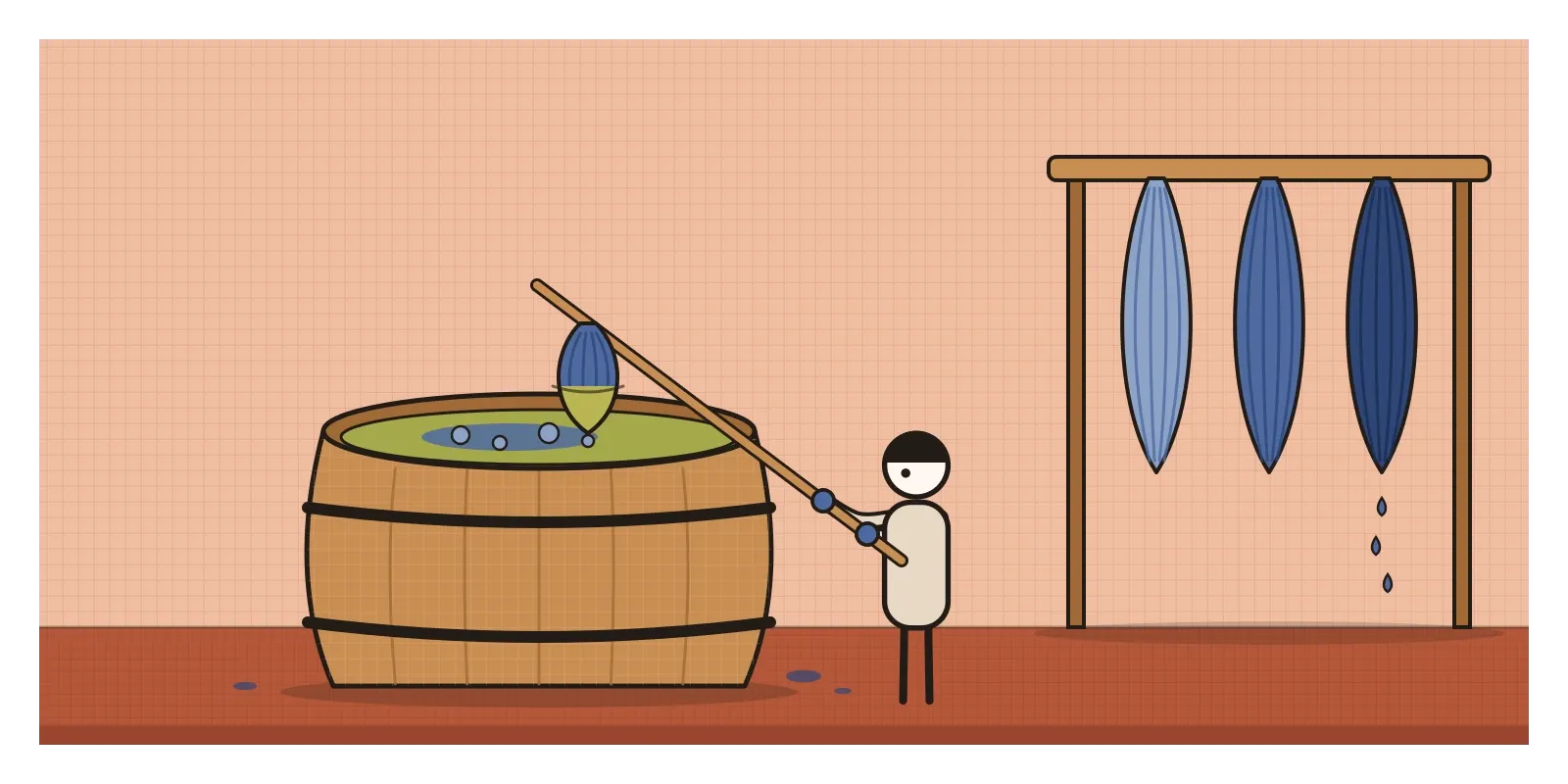
So he went to learn how to make them. He read old herbals and French dyeing manuals, and he stood at Wardle's vats in a workman's smock, dipping skeins of wool and silk again and again. Indigo is a strange dye. In the vat it's a muddy yellow-green, and the cloth only turns blue when it comes out and meets the air, a little darker with each dip. Morris's letters from Leek joke about hands stained blue to the wrists, and they also show plenty of friction, because Wardle's dyers found his perfectionism exhausting. He kept at it for about three years, until he could get the colours he wanted.
A famous designer up to his elbows in a vat, because he refused to accept what industry offered, is a good way into the Arts and Crafts movement. It was a loose movement of designers, architects and craftspeople, beginning in Britain around 1860 and spreading to Europe and America by about 1910, who believed that ordinary things should be made well, from honest materials, by people who took pleasure in making them. It was as much a set of ideas about work as a style. I mentioned Morris briefly in the post on design, art and craft. Here I want to look at the whole conversation around him.
A cathedral, a red house and a thrush
By the middle of the nineteenth century, Britain was the world's workshop. Steam-powered mills printed miles of patterned cloth and wallpaper, and machines stamped, cast and pressed ornament onto almost anything. The Great Exhibition of 1851, which has its own post in this section, showed off the results, and many critics thought they were a mess: furniture smothered in carving, ornament borrowed from every century at once. Making had also been split apart: one person designed, often far away, and another repeated one small task all day.
The sharpest attack on that split came from the critic John Ruskin. In a chapter called "The Nature of Gothic", in The Stones of Venice (1853), he praised the rough, irregular carving of medieval cathedrals because it showed that the carvers had been free to think. A perfectly finished modern object, made by dividing labour into tiny tasks, showed the opposite: a worker turned into a machine. Morris read Ruskin at Oxford with his lifelong friend Edward Burne-Jones, and much later printed the chapter on his own press.
The movement also grew out of the Pre-Raphaelites, the subject of the previous post, with their love of medieval colour and detail. When Morris married Jane Burden in 1859, his friend the architect Philip Webb designed them a house at Bexleyheath, then a village in Kent. Red House, finished in 1860, is plain red brick under a steep tiled roof, its rooms arranged around how they would be used rather than to make a symmetrical front. Morris and his friends designed, painted and embroidered much of what went in it, and the fun they had led, in 1861, to a firm selling furniture, stained glass and decoration made the same way. It later became Morris & Co.
Morris's wallpapers and textiles are the movement's best-known works. He designed around fifty wallpapers and many fabrics, almost all built from plants: willow, acanthus, honeysuckle, tulips. In 1881 the firm moved its making to Merton Abbey, on the River Wandle in Surrey, where the water suited dyeing. There, in 1883, it produced Strawberry Thief, a cotton printed with thrushes stealing fruit, said to be based on birds Morris watched in the kitchen garden of Kelmscott Manor, his country house in Oxfordshire.
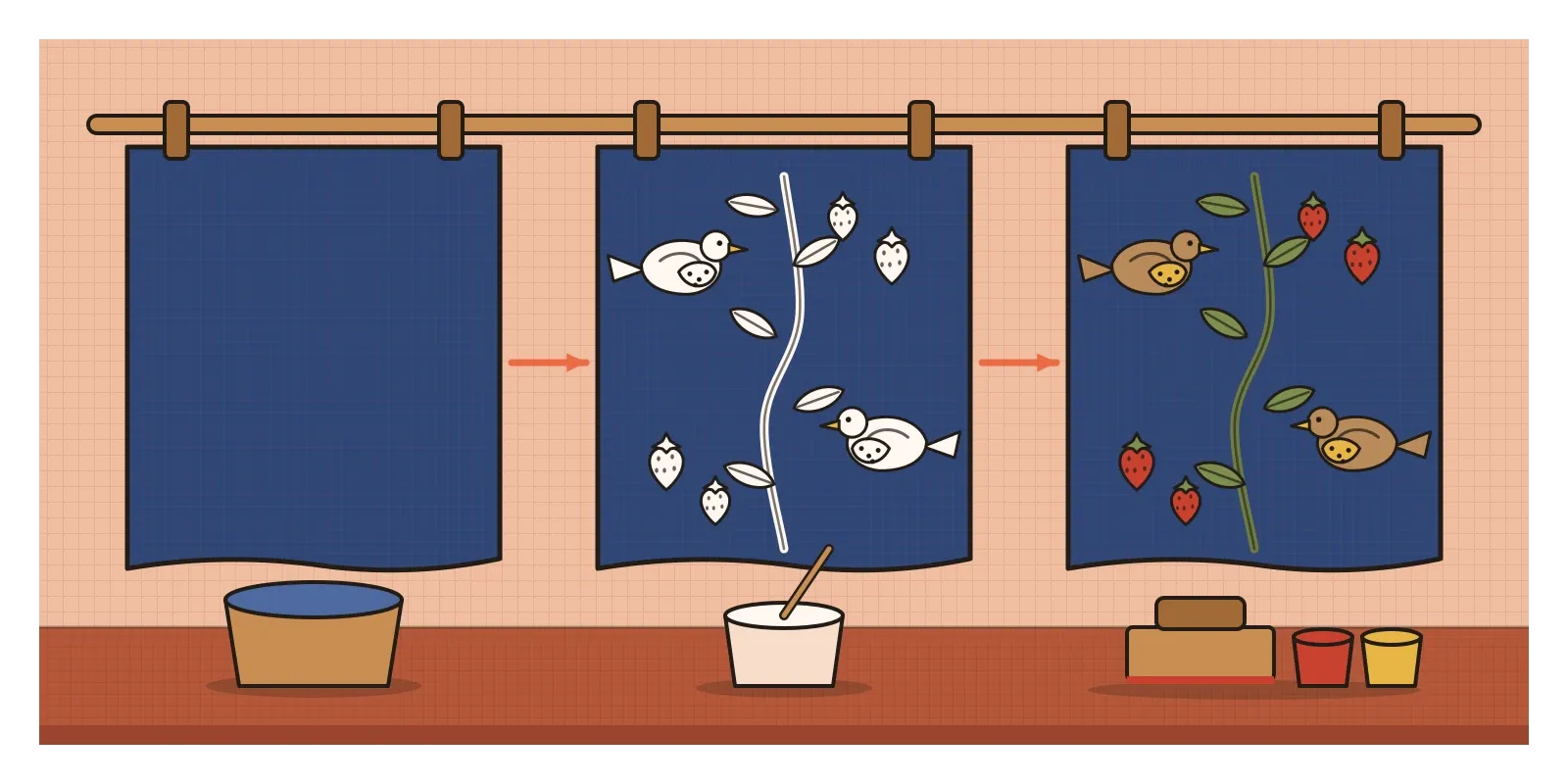
It was made by indigo discharge printing, the process Morris had learned to love at Leek. The whole cloth was first dyed blue. A bleaching paste was then printed wherever other colours would go, removing the blue, and reds and yellows were block-printed into those pale spaces, some overlapping the blue to make greens. It took days, and made Strawberry Thief one of the firm's most expensive cottons, and one of its most popular.
In 1891 Morris set up the Kelmscott Press in Hammersmith to print books by hand, on handmade paper, in typefaces he designed after studying early printed books. Its masterpiece, a Chaucer with eighty-seven woodcuts by Burne-Jones inside dense borders of vines by Morris, appeared in 1896, a few months before he died. It's one of the most admired books ever printed, and one of the heaviest to read.
Others carried the ideas on. The architect C. R. Ashbee founded the Guild of Handicraft in the East End of London in 1888, and in 1902 moved it, with some 150 craftsmen and their families, to Chipping Campden in the Cotswolds, hoping to rebuild a working village of makers. The movement got its name in 1887, when the bookbinder T. J. Cobden-Sanderson suggested it for a new Arts and Crafts Exhibition Society. Morris's daughter May ran the firm's embroidery and became one of the leading designers of her generation. In America, the furniture maker Gustav Stickley spread the ideas through his magazine The Craftsman from 1901.
Joints you can see and leaves that lie flat
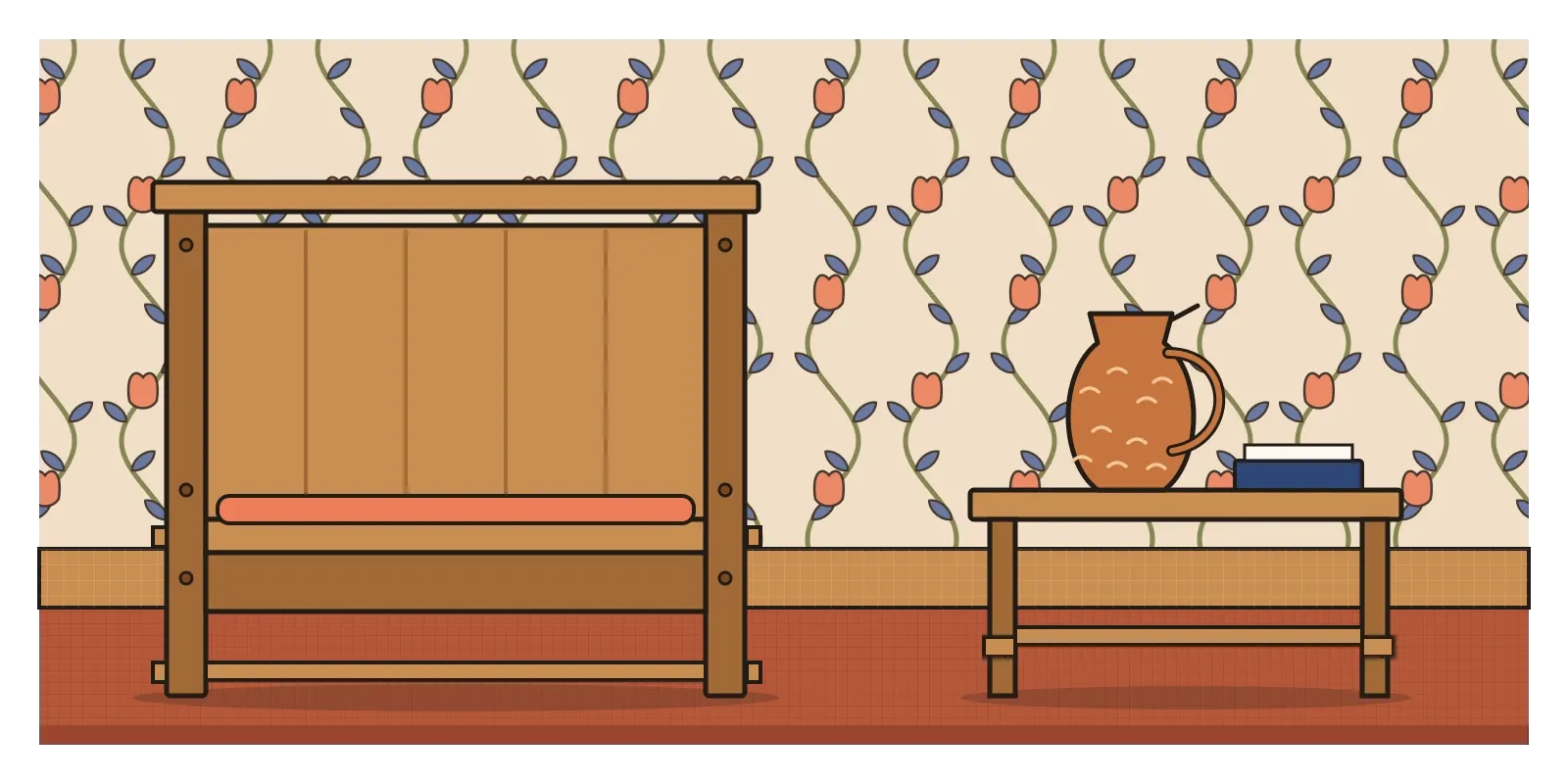
Arts and Crafts design shows frankly how it was made. Furniture is often oak, with the joints left visible: pegs, dovetails and tenons poking through and becoming part of the decoration. Chairs have rush seats. Metalwork keeps its hammer marks, so a copper jug has a softly dimpled surface that catches the light unevenly. Nothing is veneered to look like something it isn't.
The patterns are the other giveaway. Morris believed a pattern on a wall should stay flat, so his plants don't pretend to be three-dimensional. There's no heavy shading and no fake carving. Stems and leaves twist and overlap in a shallow, dense space, organised so the repeat is hard to spot. The colours come from natural dyes and are a little softened, indigo, madder, olive and warm yellow, sitting together without shouting. In books, the look is heavy black type, wide margins, woodcut borders and the idea that two facing pages are a single design.
Read with a designer's eye, the vocabulary is about truth to materials and visible process. The joint is the ornament. The surface records the tool. The pattern respects the wall it sits on. It's a style built out of a moral argument, which is both its strength and, as we'll see, its weakness.
Lahore, Osborne and a chapel in the Cotswolds
Many Arts and Crafts designers held up Indian craft as proof that their ideal was real: a country where weavers, potters and carvers still worked by hand, in families and guilds. The admiration was genuine, and it was also tangled up with a colonial habit of seeing India as timeless, a living museum of the past.
John Lockwood Kipling, a designer trained in the circle of the South Kensington Museum and father of the writer Rudyard Kipling, turned the ideas into an institution. In 1875 he became the first principal of the Mayo School of Art in Lahore, which, unlike many colonial art schools, put Indian crafts such as woodcarving and metalwork at the centre of its teaching. One of its students and later teachers, Bhai Ram Singh, became a remarkable architect. In 1890 and 1891, working with Kipling, he designed the Durbar Room at Osborne House on the Isle of Wight, a banqueting hall for Queen Victoria covered in intricate white plaster carving in an Indian style.
The ideas also travelled the other way. Ananda Coomaraswamy, whose thoughts on art and craft I wrote about in the post on design, art and craft, settled in 1907 at Broad Campden, near Ashbee's guild, in an old Norman chapel that Ashbee restored for him. His book Mediaeval Sinhalese Art was printed there in 1908, according to its colophon on the very press Morris had used for the Chaucer. In The Indian Craftsman (1909), with a foreword by Ashbee, he argued that India's village and guild craftsmen already lived the life Morris dreamed of, and that colonial trade and cheap imported machine goods were destroying it. That argument fed the Swadeshi movement, which from 1905 urged Indians to buy Indian goods, and later Gandhi's hand-spun khadi, which I wrote about in the post on texture. Morris wanted to rebuild a world of craft Britain had lost. Indian thinkers used his ideas to defend one that Britain was dismantling.
Craft as the thing everyone now sells
The movement's influence is still everywhere. Morris & Co. patterns are still printed, and in 2020 the high-street chain H&M sold a collection made with them, a slightly ironic fate for a socialist who hated cheap goods. The belief that designers should understand their material, and get their hands into it, runs from Morris at the vat to the Bauhaus workshops and on to every product designer who prototypes in code instead of handing over static pictures. And the central reaction keeps repeating. When factories made perfect ornament cheap, the irregular handmade thing became precious. Now that AI tools can generate a polished image in seconds, visible process, hand-drawn marks and the story of who made something are becoming the signs of value again.
Swinish luxury, and a blue that came from Bengal
The movement's biggest problem was one Morris saw himself. Handmade things are slow, and slow things are expensive. He is reported to have burst out, while working on a rich client's house, that he spent his life ministering to the swinish luxury of the rich. The working people he believed in, as a committed socialist, couldn't afford what his workshops made. Ashbee's guild hit the same wall and had failed by 1908, partly because the London store Liberty was selling machine-made silver with a convincingly hand-hammered look for less.
There were other blind spots. Its picture of the Middle Ages, full of happy craftsmen in free guilds, was more dream than history. Its workshops often kept a hierarchy in which men designed and women stitched, and the Art Workers' Guild, founded in 1884, didn't admit women, which is why May Morris co-founded the Women's Guild of Arts in 1907. And its love of natural dye hid a harsher story. Natural indigo in Victorian Britain came overwhelmingly from British India, where European planters forced peasants to grow it on ruinous terms. In 1859 and 1860, indigo farmers in Bengal rose against them, and Dinabandhu Mitra's play Nil Darpan, the mirror of indigo, made their suffering famous. In Bihar the system lasted until Gandhi's first great campaign in India, at Champaran in 1917. The movement wrote beautifully about the dignity of labour, but rarely followed its own supply chain that far.
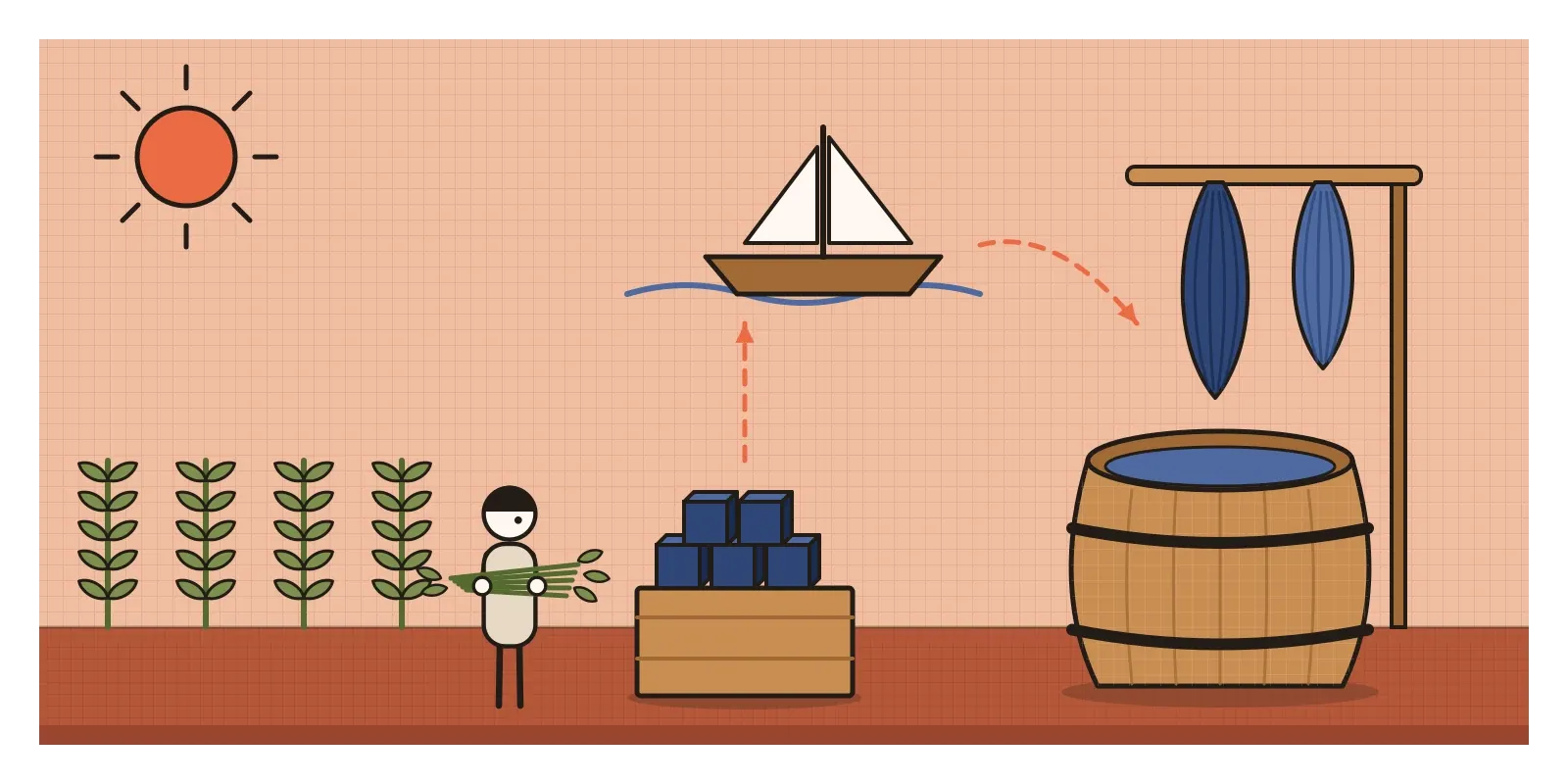
Chemistry and the market overtook it. The German firm BASF began selling synthetic indigo in 1897, and the natural trade collapsed within a couple of decades. In design, the next generations kept the ideals but made peace with the machine. The Deutscher Werkbund, from 1907, and later the Bauhaus argued that good design should be made by industry for everyone, not by hand for a few.
Go and see the vats, then draw a flat leaf
In London, the William Morris Gallery in Walthamstow, in the house where he grew up, shows his patterns, dye samples and printing blocks, and Red House is open to visitors. In India, spend an afternoon at the Crafts Museum in Pragati Maidan in Delhi, among the kind of hand-making Kipling and Coomaraswamy admired. For a small exercise, pick a plant you can see from your window and draw it as a flat pattern, the way Morris would: no shading, twisting stems, leaves filling the space evenly. Then try to make it repeat so the joins are hard to find.
Morris could have bought his colours. Instead he stood at a vat in Leek until his hands turned blue, because he believed the way a thing is made is part of what it means. That belief, generous, stubborn and sometimes blind to its own costs, is what the Arts and Crafts movement handed on. In the next post, on Impressionism, a group of painters in Paris answer their own establishment in a very different way, by taking their easels outdoors to catch the light before it changed.
Further reading: Fiona MacCarthy, William Morris: A Life for Our Time (1994) · John Ruskin, "The Nature of Gothic", in The Stones of Venice, vol. 2 (1853) · Ananda K. Coomaraswamy, The Indian Craftsman (1909) · Rosalind P. Blakesley, The Arts and Crafts Movement (2006) · Linda Parry, William Morris Textiles (1983)
A reply toMachine-made ornament, and a factory system that split designing from making.