Ancient Roman Art
How Rome borrowed Greek beauty and put it to work in concrete, mosaic, portraits and letters.
Ancient Roman Art
A sign-writer reads Trajan's letters
In the middle of the twentieth century, an American priest called Edward Catich spent months in Rome staring at a single slab of marble. Before he was ordained, Catich had worked as a sign-writer in Chicago, painting lettering on shop windows with a flat brush, and he had become obsessed with the inscription carved on the base of Trajan's Column. The column was dedicated in 113 CE in the emperor's new forum, and the panel above its door holds six lines of capital letters, each around ten centimetres tall, recording that the Senate and People of Rome set it up. Letter designers had long treated them as the most perfect capitals ever made. Catich took rubbings and noticed something odd about the strokes. Their thick and thin parts swelled and tapered exactly as they do when you write with a flat brush, and the little feet at the ends of the strokes, the serifs, looked like the place where a brush is twisted and lifted.
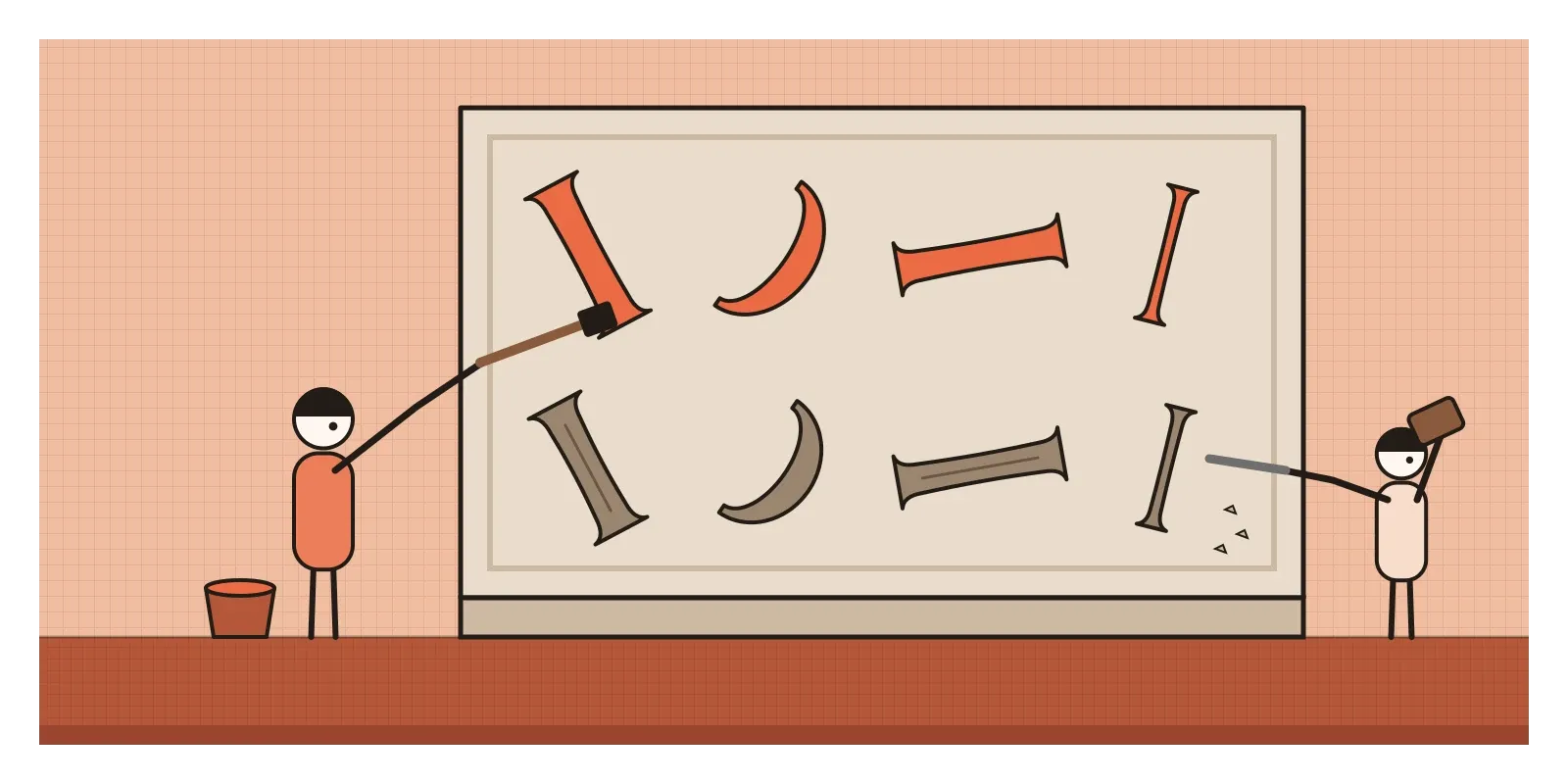
In 1968 he published his argument in a book called The Origin of the Serif. The letters, he said, were first painted onto the stone with a brush, and the carver followed the paint. Not everyone accepts all of it, and some historians credit the chisel as much as the brush. But a sign painter's hand underneath the most admired letters in the West is very Roman: skilled, practical people making beautiful things at the scale of an empire.
Ancient Roman art is the art and architecture made by the Romans and the people they ruled, from the early Republic, around 500 BCE, to the fall of the Western Empire in 476 CE. It includes portraits, wall paintings, mosaics, coins and carved reliefs, but its greatest achievements were often engineering: roads, aqueducts, arches and domes.
Captive Greece took its conqueror captive
Rome began as one small city among many in central Italy, borrowing heavily from its neighbours the Etruscans, who were skilled in terracotta, bronze and the arch. As it expanded through the third and second centuries BCE, it met the Greek cities of southern Italy and then Greece itself. When Roman armies sacked Corinth in 146 BCE, statues, paintings and treasures were shipped back to Rome by the boatload. Wealthy Romans filled their houses and gardens with Greek sculpture, and when they couldn't get originals, they ordered copies. Much Greek sculpture survives only in these Roman copies, as I mentioned in the post on proportion systems.
The poet Horace summed up the paradox in one line: "Captive Greece took captive her savage conqueror." The Romans conquered Greece by force, and Greek art conquered Roman taste. So Roman art grew up as a reply to the Greek ideal, the calm, perfected body and the harmonious temple of the post on ancient Greek art. Rome copied that ideal endlessly and then bent it to new uses. Greek art had mostly served cities and gods. Roman art served an empire stretching from Britain to Syria, with practical jobs to do: house crowds, carry water, put the emperor's face into every purse and tell conquered peoples who was in charge.
A spiral of war, a sphere of air and a million tiny stones
Trajan's Column itself is around thirty metres tall, and a band of relief about two hundred metres long winds up it more than twenty times, telling the story of Trajan's two wars against the Dacians, in present-day Romania. Soldiers build bridges, march, fight and besiege towns, and the emperor appears again and again. It's a comic strip wrapped round a pole, with more than two thousand figures, and it was probably once painted.
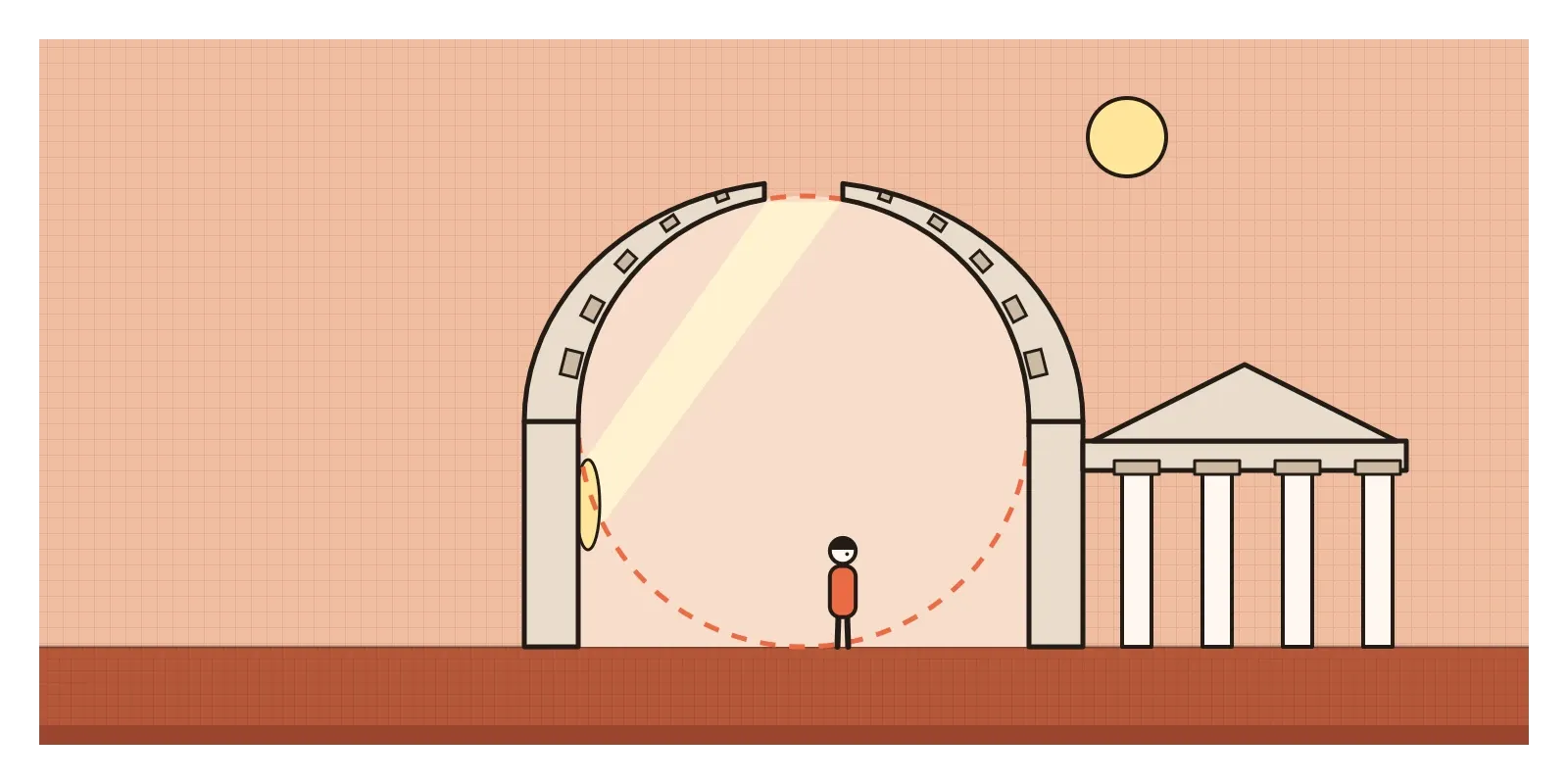
A few years later, under the emperor Hadrian, the Pantheon was rebuilt in Rome, probably between about 118 and 125 CE. Behind a conventional temple porch you walk into a vast concrete drum covered by a dome, with a round opening, the oculus, about eight metres across at the very top. The interior is built around a perfect geometry: the height from the floor to the oculus is the same as the diameter of the dome, so a sphere would fit exactly inside it. The only light comes through the oculus, and a disc of sunlight slides across the coffered ceiling and walls through the day. Almost two thousand years later, it's still the largest dome of unreinforced concrete in the world.
Roman art also lived on floors and walls. In the House of the Faun in Pompeii, buried by Vesuvius in 79 CE, excavators found the Alexander Mosaic, made around 100 BCE and now in the National Archaeological Museum in Naples. It shows Alexander the Great charging at the Persian king Darius in a crush of horses, spears and frightened faces, and it's made of well over a million tiny pieces of coloured stone, called tesserae. It's probably a copy of a lost Greek painting: Rome's admiration for Greece, turned into a floor.
And then there are the faces. Around the first century BCE, Roman patricians had themselves carved with startling honesty: sagging cheeks, wrinkles, warts, thinning hair. A famous marble in Rome, often called the Barberini Togatus, shows a man in a toga holding the portrait heads of two ancestors, a reminder that Roman families kept wax masks of their dead and paraded them at funerals. This blunt style is usually called verism, from the Latin word for true.
Curves, concrete and capital letters
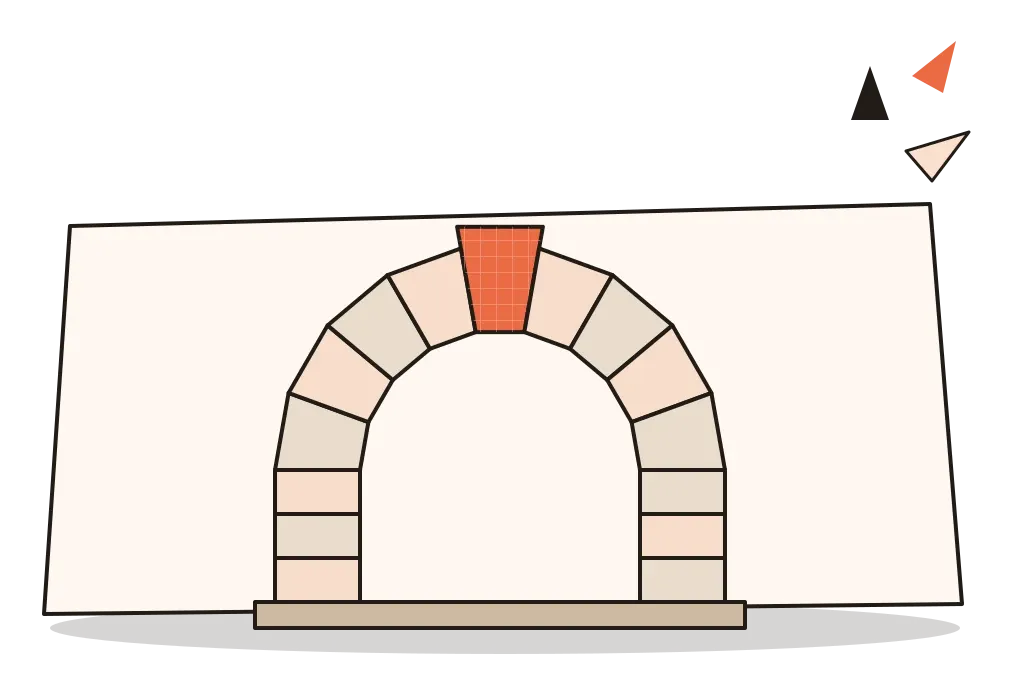
If Greek architecture is posts and beams, Roman architecture is curves. The Romans didn't invent the arch, but they used it on a scale nobody had tried before. An arch is made of wedge-shaped stones, called voussoirs, with a keystone at the top locking them together, and it carries weight around an opening rather than across it. Stack arches in rows and you get an aqueduct like the Pont du Gard in southern France, three tiers of arches carrying water across a river valley. Extend an arch and you get a vault; rotate it and you get a dome. Much of this was made possible by concrete, which the Romans mixed from lime, rubble and volcanic ash and poured into shapes stone alone couldn't make.
Roman builders used the Greek orders, the column styles I described in the post on proportion systems, but often as decoration, applied to the face of a concrete wall rather than holding anything up. The Colosseum does this, with a different order on each storey. Inside houses, walls were painted with fake marble, gardens and architecture that seemed to open the room outwards, often against deep reds and blacks.
Then there's lettering, the part most designers know without realising it. The monumental Roman capital, with its contrast between thick and thin strokes, wide round O and C, narrower E and S, and small serifs, became the model for capital letters in almost every Western typeface. The Romans had no lowercase letters, no J, U or W, and they spaced their words with small dots. Everything we now call uppercase descends from their stone letters, often by way of the brush.
Pepper, ivory and a goddess in Pompeii
In 1938, archaeologists digging in Pompeii found a small ivory statuette, about twenty-five centimetres tall, in the ruins of a house. It shows a woman, almost naked, heavily adorned with jewellery, flanked by two small attendants, and it was certainly made in India. Similar figures have been found at Bhokardan in Maharashtra, then part of the Satavahana kingdom, and many scholars think it was carved there or nearby. It's often called the Pompeii Lakshmi, although nobody is sure whom it represents. It may be a goddess, a yakshi or simply a figure of feminine auspiciousness, and it may have been the handle of a mirror. What we do know is that it reached a Roman town before 79 CE.
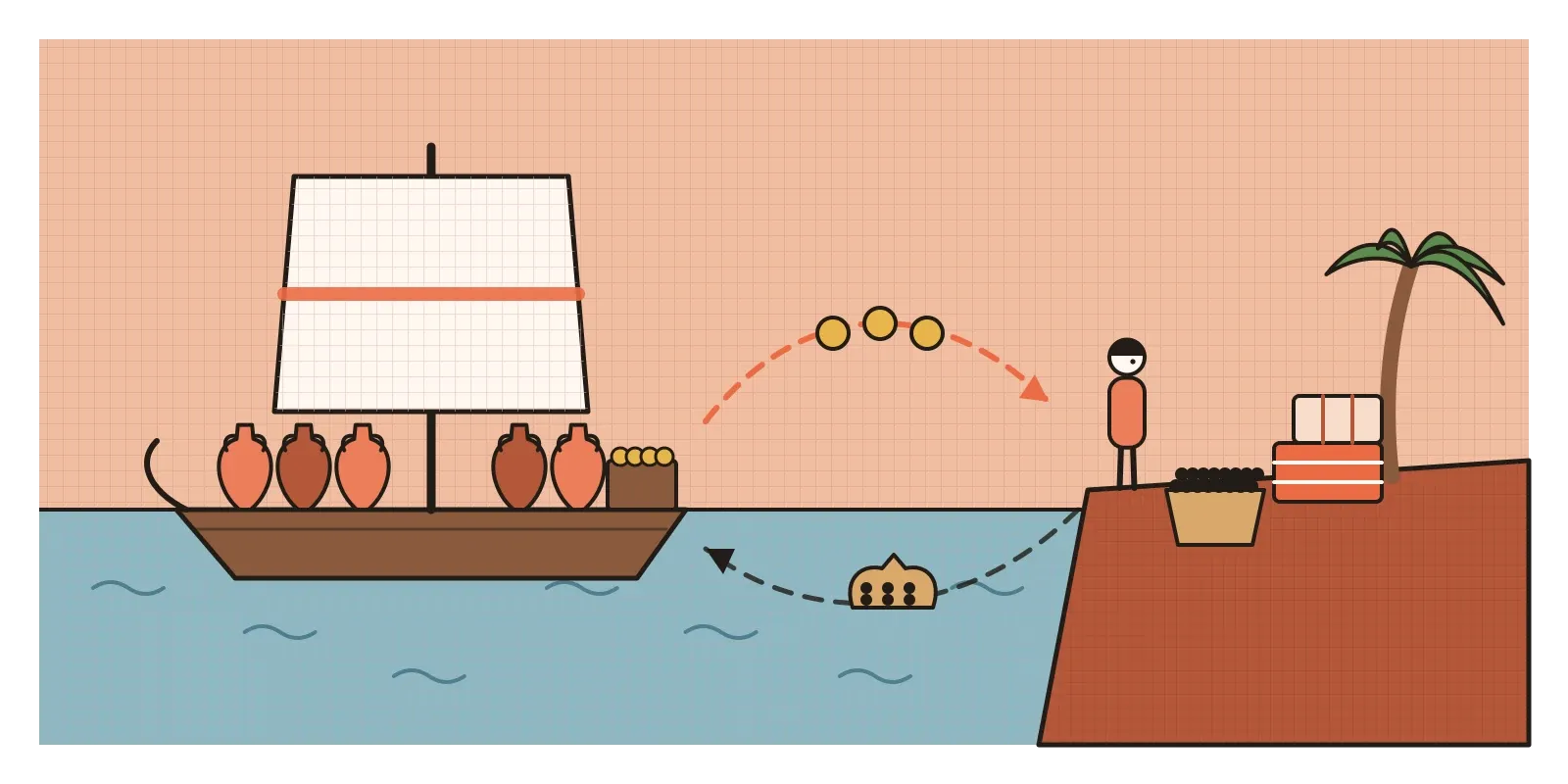
It wasn't alone. In the first centuries of the Common Era, ships sailed from Egypt's Red Sea ports to India using the monsoon winds, and a first-century Greek merchant's guide, the Periplus of the Erythraean Sea, lists the harbours and goods along the way. Romans wanted Indian pepper, textiles, gems and ivory. In return came wine, olive oil and, above all, gold and silver coins. Pliny the Elder grumbled that India drained the empire of millions of sesterces every year. Hoards of Roman coins have been found across south India, and at Arikamedu, just south of Puducherry, Mortimer Wheeler's excavations in 1945 turned up Roman amphorae and red-gloss pottery from Italy. Muziris, the great pepper port on the Kerala coast, appears in a second-century papyrus recording a loan for a cargo shipped from there.
The artistic influence was uneven. Roman goods were luxuries in India rather than models, and Indian sculptors needed no lessons in carving. The clearest visual traces of Rome in the subcontinent are in the far northwest, in Gandhara, where Greek and Roman ideas about drapery and the body mixed with Buddhist subjects, which I'll come to in the next post.
Capitals on film posters and domes in Delhi
Rome's most obvious legacy for designers is in type. In 1989 Carol Twombly designed Trajan for Adobe, a digital typeface of capitals only, drawn directly from the inscription Catich studied. It became a film-poster cliché for anything epic. Look at the capitals in almost any serif typeface, from Times New Roman to Garamond, and you'll see the same proportions: round letters wide, others narrower, strokes swelling and thinning. Catich reminds us that typefaces began as the movement of a hand.
Roman architecture became a language for authority. Banks, courts and parliaments wear porticos and domes because Rome taught Europe that columns mean permanence and a dome means power. Rashtrapati Bhavan in New Delhi, designed by Edwin Lutyens and completed in 1929, is often said to take its dome partly from the Pantheon and partly from the stupa at Sanchi, a deliberate mix of Roman and Indian authority.
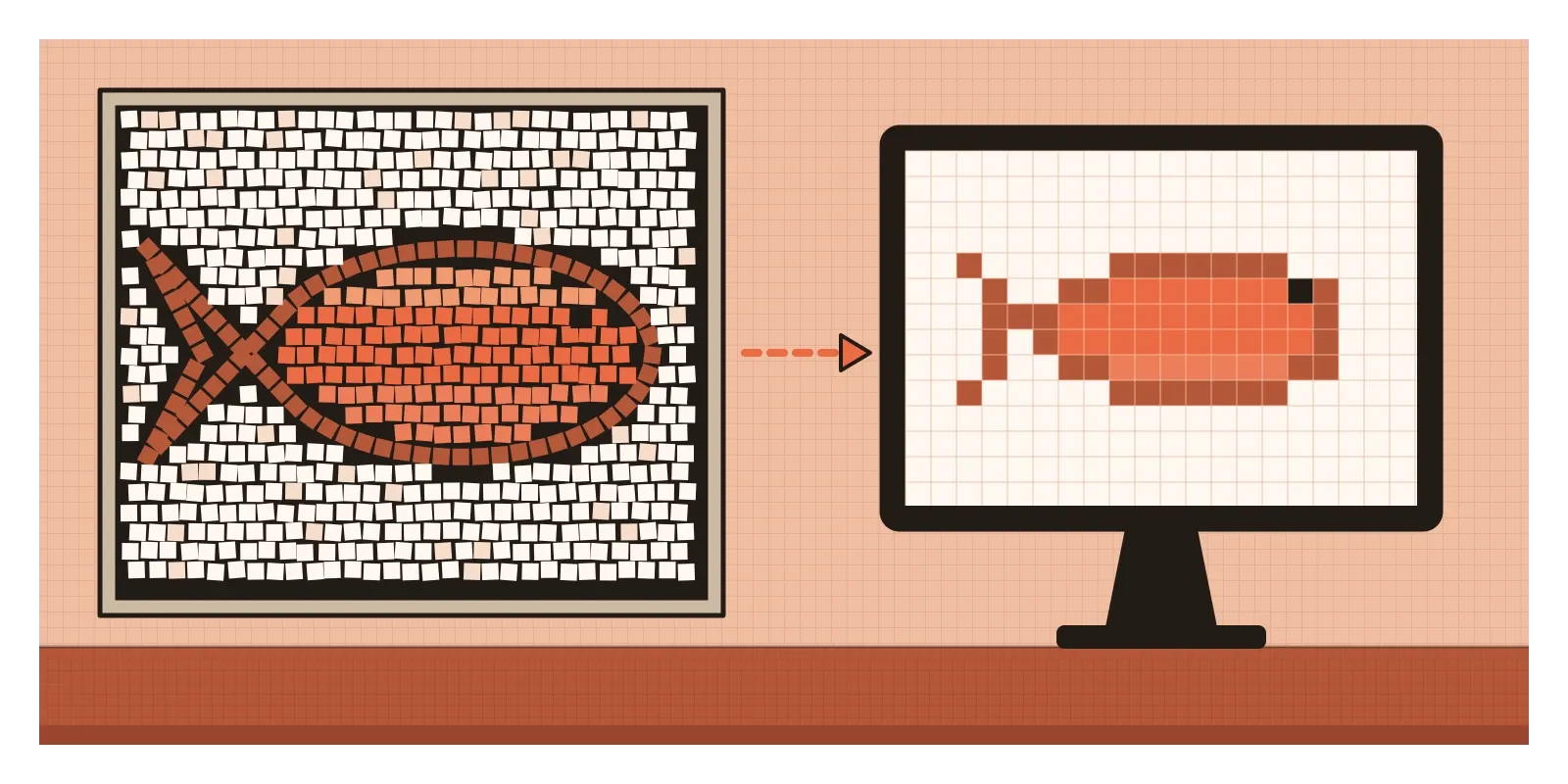
Mosaic is another quiet ancestor. A Roman mosaicist building an image from small square tesserae was solving the same problem as a screen building one from pixels: how to make curves, faces and shading out of a grid of single-coloured units. Good mosaicists laid their tesserae in rows following the edges of a form to keep outlines crisp, a problem pixel artists know well. And Rome's habit of standardisation, from stamped bricks to road widths and coins with the emperor's face struck the same way across a continent, is the ancestor of the brand guidelines and design systems I work with.
Built by many hands, signed by emperors
For a long time, Roman art had a poor reputation. In the eighteenth century, the German scholar Johann Joachim Winckelmann made Greek art the summit of beauty, and Roman art looked like a copy of a copy. Only around 1900 did historians such as Franz Wickhoff and Alois Riegl argue for its own achievements. The deeper criticisms are different. Much of it was built by enslaved people and soldiers, and its makers are almost all anonymous, while emperors put their names on everything. Trajan's Column is a masterpiece and also war propaganda, celebrating the conquest of a people. Roman art was an instrument of empire, and it was very good at it.
There isn't a single end. The West fell in 476 and the East carried on from Constantinople. Already on the Arch of Constantine, completed in 315 CE, new reliefs show stiff, frontal, rather doll-like figures beside older panels taken from monuments of Trajan's time. Historians once called this decline. Many now see a new way of seeing, less interested in the visible world and more in rank and meaning, which leads towards Byzantine art, the reply I'll write about a few posts from now.
To see it this week, you don't need to go to Rome. The Pondicherry Museum shows finds from Arikamedu, and a visit to Rashtrapati Bhavan or the domes of Lutyens' Delhi is a walk through Rome's afterlife. For a small exercise, hold a broad chisel-tipped marker at a steady angle of about thirty degrees and write capital O, H and N. Thick and thin strokes appear without trying. Twist the marker as you finish a stroke and a serif appears. It's the experiment Catich spent years on, in a few minutes. In the next post, on ancient Indian art, I'll look at what was being carved and painted on the other end of those trade routes.
Further reading: Edward M. Catich, The Origin of the Serif: Brush Writing and Roman Letters (1968) · Mary Beard, SPQR: A History of Ancient Rome (2015) · Nancy H. Ramage and Andrew Ramage, Roman Art: Romulus to Constantine (1991) · Raoul McLaughlin, Rome and the Distant East (2010)
A reply toThe perfected Greek ideal, admired, copied and put to work for an empire.