AI-Generated Aesthetics
How image generators produced a look of their own within months, and the fights over credit, copyright and work that came with it.
AI-Generated Aesthetics
A blue ribbon at the state fair
At the end of August 2022, the Colorado State Fair in Pueblo announced the winners of its annual fine arts competition. First prize in the category for digital art and digitally manipulated photography, a blue ribbon and $300, went to a tabletop game designer named Jason M. Allen for a picture called Théâtre D'opéra Spatial. It showed robed figures standing in a vast, golden hall like an opera house, looking out through a huge round opening at a glowing landscape.
Allen had made it with Midjourney, an AI image generator that turns a written description, called a prompt, into a picture. He had entered it under the name "Jason M. Allen via Midjourney", after working through hundreds of prompts and touching up the result in Photoshop. When he posted about the win online, the reaction was furious. Artists accused him of taking a prize from people who had spent years learning to paint. He told The New York Times that he wouldn't apologise. The judges said they hadn't known what Midjourney was, but would have chosen the picture anyway. A year later, the US Copyright Office refused to register the image, because most of it hadn't been made by a human author, and Allen went to court to challenge that decision.
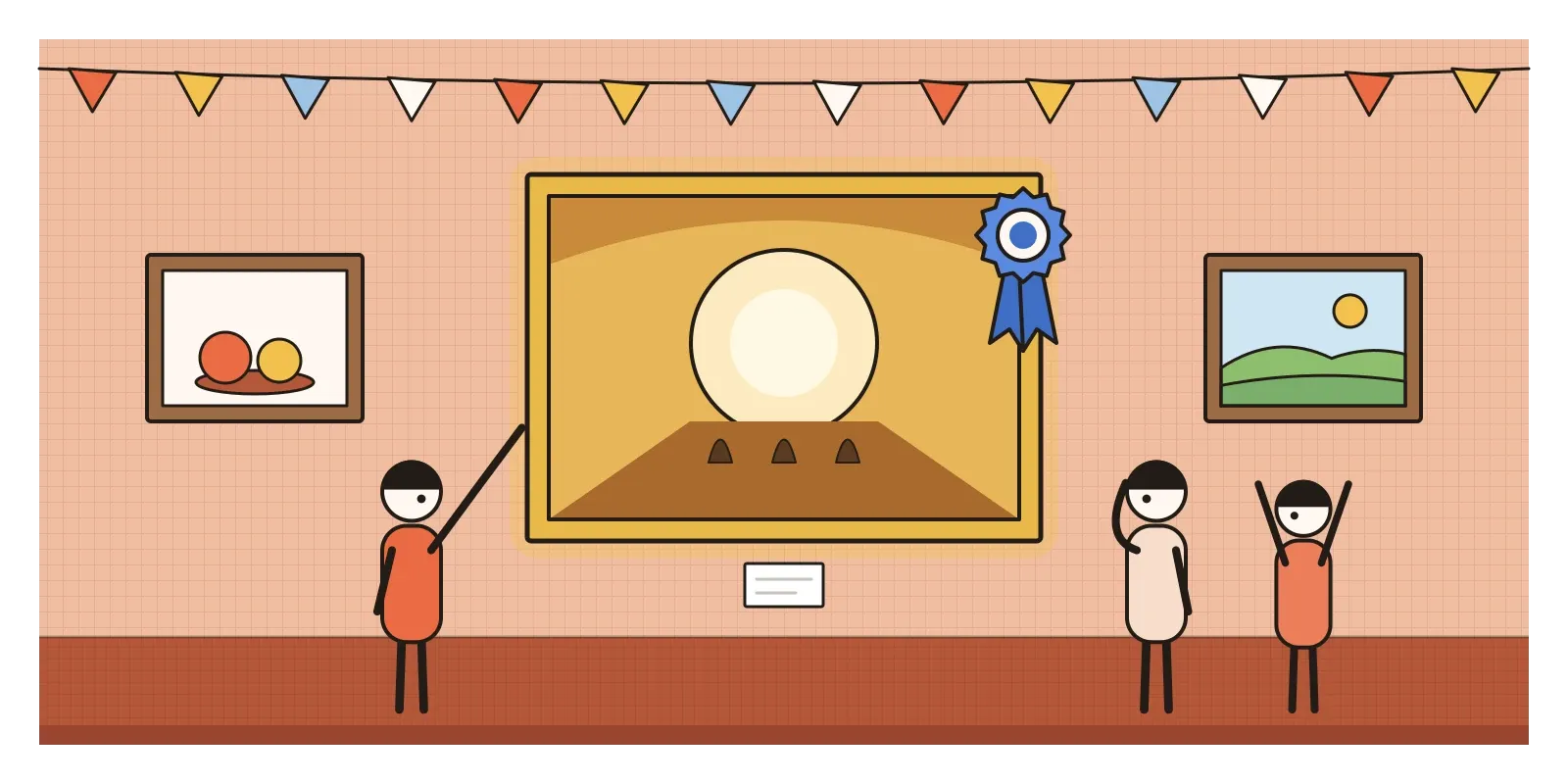
That ribbon gathered the AI image era's arguments into one hall: what counts as making a picture, who deserves credit, and whose work the machine learned from. This post is about AI-generated aesthetics, the looks and the debates that grew up around images made by machine-learning models trained on enormous collections of existing pictures. It isn't a movement with a manifesto. It's a technology that arrived very fast, produced a style of its own within months, and forced everyone who makes images to take a position.
Dreaming dogs, an avocado armchair and a portrait at auction
Computers had made art for decades before this. In the post on computational and generative art, I wrote about the plotter drawings of the 1960s and Harold Cohen's drawing program AARON, which followed rules its makers had written by hand. The new tools learned patterns from examples instead. In 2014, the researcher Ian Goodfellow and his colleagues described the generative adversarial network, or GAN, in which one network makes images and a second tries to tell them apart from real ones, and both improve by competing. In 2015, Google's DeepDream, which I mentioned in the post on psychedelic design, filled photographs with dog faces and eyes, and a paper by Leon Gatys and his colleagues showed how to repaint any photo in the style of a famous painting.
Artists began working with GANs almost at once. In October 2018, Christie's in New York sold Edmond de Belamy, a blurred portrait of a man in a dark coat made by the Paris collective Obvious, for $432,500, many times its estimate. The sale was a sensation and a row, because the collective's code drew heavily on open-source work by a young American programmer, Robbie Barrat, who received nothing from it. The British artist Anna Ridler took a slower route. For Mosaic Virus (2018 to 2019), she photographed and labelled thousands of tulips herself, trained a model on them, and had it generate flowers whose stripes changed with the price of bitcoin, a nod to the Dutch tulip mania of the 1630s. Refik Anadol's Unsupervised (2022 to 2023) filled the lobby of the Museum of Modern Art in New York with shifting, liquid imagery from a model trained on the museum's own collection.
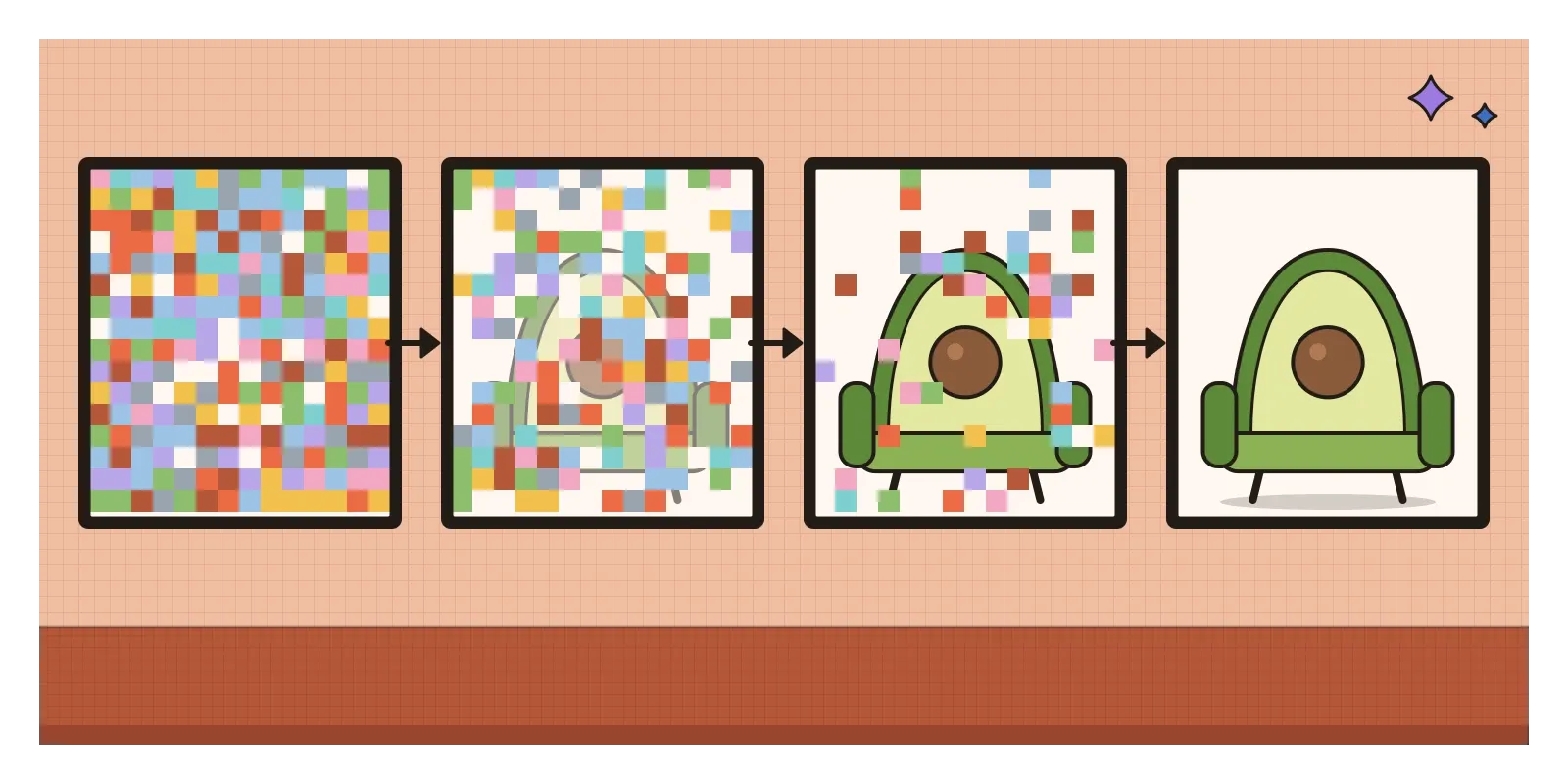
Then came tools anyone could use. In January 2021, OpenAI showed DALL-E, and the example everyone remembers was an armchair in the shape of an avocado. In 2022, three tools arrived within months of each other: DALL-E 2 in April, Midjourney's open beta in July and Stable Diffusion in August, released openly so anyone could run it at home. They used a newer method called diffusion, which starts from random noise and removes it step by step until an image appears that matches the prompt. They had learned from billions of pictures and their captions collected from the web, including a public dataset called LAION-5B.
So what were these images replying to? Partly to the stock photograph, the bland, licensed picture that had filled websites and slide decks for twenty years, and to the hours of skilled work a convincing illustration used to need. Partly, and more uncomfortably, they were a reply to the internet itself: a huge shared archive of pictures made by people, which the models absorbed and handed back as averages.
Golden light on everything
Within a few months, people could spot an AI image across a room. The early tells, six-fingered hands and signs full of nonsense letters, faded as the models improved. What stayed was a look. The default AI image is glossy and cinematic, with dramatic rim lighting, a shallow depth of field that blurs the background, warm oranges set against cool teals, and an even, airbrushed smoothness on skin and surfaces. Everything is detailed, everywhere, with no part of the picture left rough or unfinished. Faces are young and symmetrical. It looks like a fantasy book cover crossed with a perfume advertisement, because those were among the most admired images in the training data.
Prompts shaped the style as much as the models did. Early users added phrases like "highly detailed", "8k" and "trending on ArtStation" to push results towards polished digital painting. In 2022, the Polish fantasy illustrator Greg Rutkowski discovered that his name had become one of the most popular prompts in Stable Diffusion, so that searching online for his work began to turn up machine imitations of it. In March 2025, when OpenAI added image generation to ChatGPT, millions of people turned their photos into pictures in the soft, hand-painted manner of Studio Ghibli, and an old clip of Hayao Miyazaki recoiling from a crude AI animation demo circulated again.
By 2024, people had a blunt word for the flood of cheap, generic AI pictures in their feeds: slop. It's unfair to the best work, but it names the risk. When the same few models make everyone's images, everyone's images start to look alike.
What the model thinks India looks like
India's first gallery exhibition of AI art is usually said to be Gradient Descent, shown at Nature Morte in New Delhi in 2018 and curated by the art collective 64/1. It included the Bengaluru artist Harshit Agrawal, who has gone on working with machine learning, often on images he has chosen himself rather than the open web.
The bigger Indian story is about representation. In 2023, the publication Rest of World asked Midjourney for pictures of people from different countries and found that its "Indian person" was almost always an old man with a beard and a turban. Because the models learn from what's most common online, they reproduce an outsider's postcard of India and flatten a country of many languages, clothes, skin tones and cities into a handful of clichés.
The politics arrived quickly too. Before the 2024 general election, the DMK in Tamil Nadu showed videos of its late leader M. Karunanidhi, who died in 2018, speaking as an AI avatar. Indian courts have started to draw lines. In 2023, the Delhi High Court granted the actor Anil Kapoor an order protecting his name, face, voice and catchphrase from unauthorised use, including by AI tools, and in 2024 the news agency ANI sued OpenAI in the same court, arguing that its reports had been used for training without permission.
There's an Indian side to the labour story as well. Much of the invisible work behind these models, labelling images and rating outputs, is done in India, Kenya, the Philippines and elsewhere. Some of it is organised with care, like the Bengaluru nonprofit Karya, which pays rural workers to record and label data in Indian languages, and some of it is very poorly paid.
A sparkle on every button
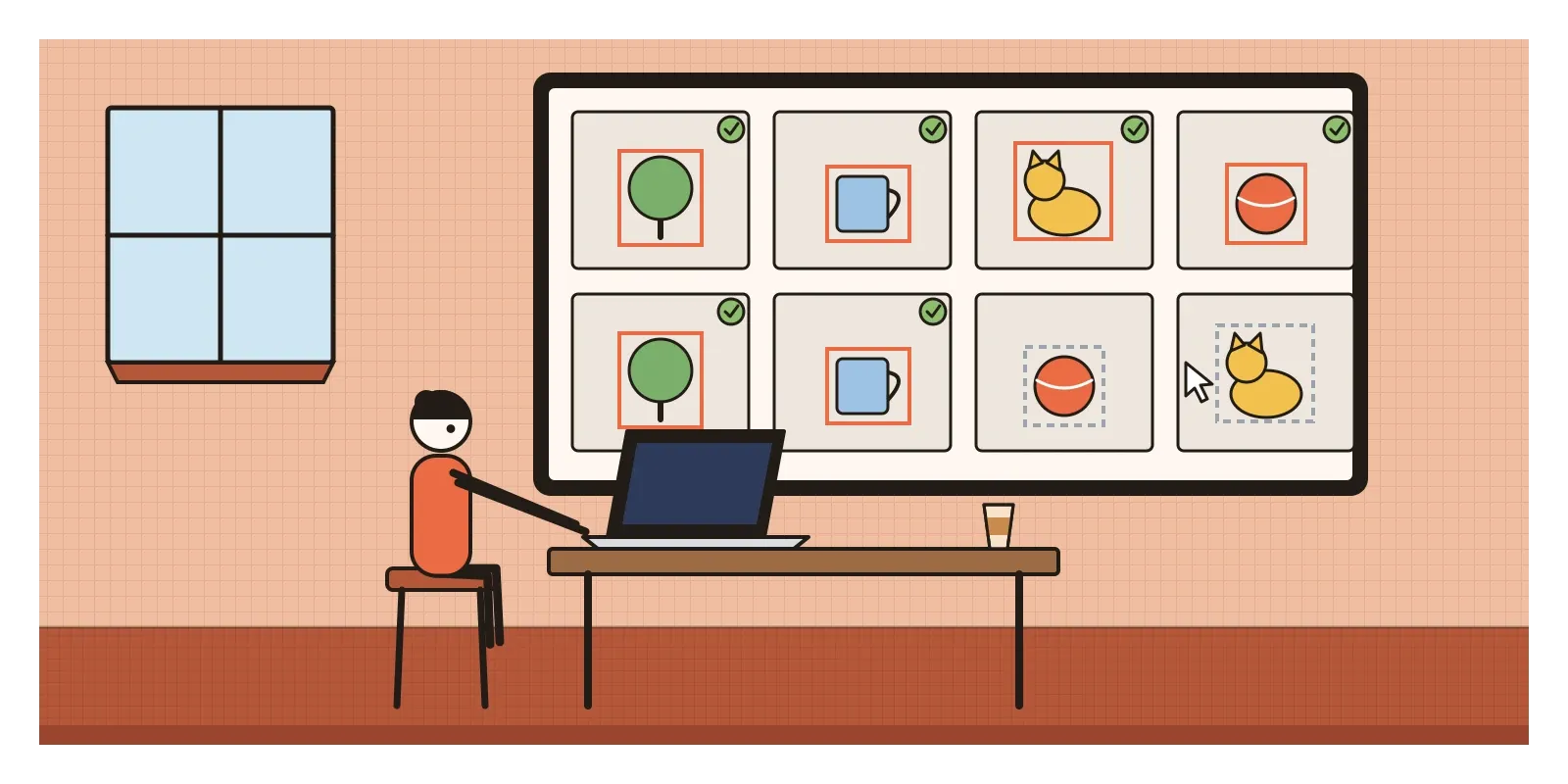
For designers, the most immediate trace is in our own interfaces. Between 2023 and 2024, almost every software company added AI features, and almost all of them marked those features the same way: a small four-pointed sparkle icon and a gradient from blue into purple or pink. It became the visual shorthand for "the machine will do this", much as the floppy disk did for saving. In my own work on AI products, the hard design questions were rarely about the sparkle. They were about showing what the system was doing, where it was unsure, and how a person could correct it.
The tools have also changed the early stages of design work. Mood boards, storyboards and concept images that once took a day can be roughed out in minutes, as long as nobody mistakes the rough for the answer. Adobe built its Firefly models into Photoshop in 2023 as Generative Fill, and says they were trained on licensed and public domain images, an attempt to answer the copyright worry. Content Credentials, a standard backed by technology companies and publishers, attaches a record of how an image was made. And the backlash has shaped taste: visible brushwork and deliberate imperfection now signal that a person was involved.
Whose pictures were they?
The fiercest debate is about training. The models learned from billions of images collected without asking the people who made them. In January 2023, the artists Sarah Andersen, Kelly McKernan and Karla Ortiz sued Stability AI, Midjourney and others in the United States, arguing that this was copying on a vast scale. Getty Images brought its own case against Stability AI in Britain. Researchers at the University of Chicago released Glaze in 2023 and Nightshade in 2024, free tools that make changes to an image, invisible to people, that confuse models trained on it.
The other side has serious arguments too. Developers say training is closer to learning than to copying, since a model stores patterns rather than the pictures themselves, and that in the United States it may count as fair use. Nobody owns a way of painting light. Supporters also point out that the tools let small businesses, students and disabled people make images they could never have commissioned. Countries are reaching different answers, slowly. Japan's copyright law is unusually relaxed about training, while the European Union now requires model providers to respect opt-outs and publish summaries of their training data. What has been fairly consistent, at least in the United States, is the other half of the question: a picture made entirely by a machine can't be copyrighted, because copyright needs a human author. In 2023 the Copyright Office decided that Kris Kashtanova's comic Zarya of the Dawn was protected for its text and the arrangement of its pages, but not for its Midjourney images.
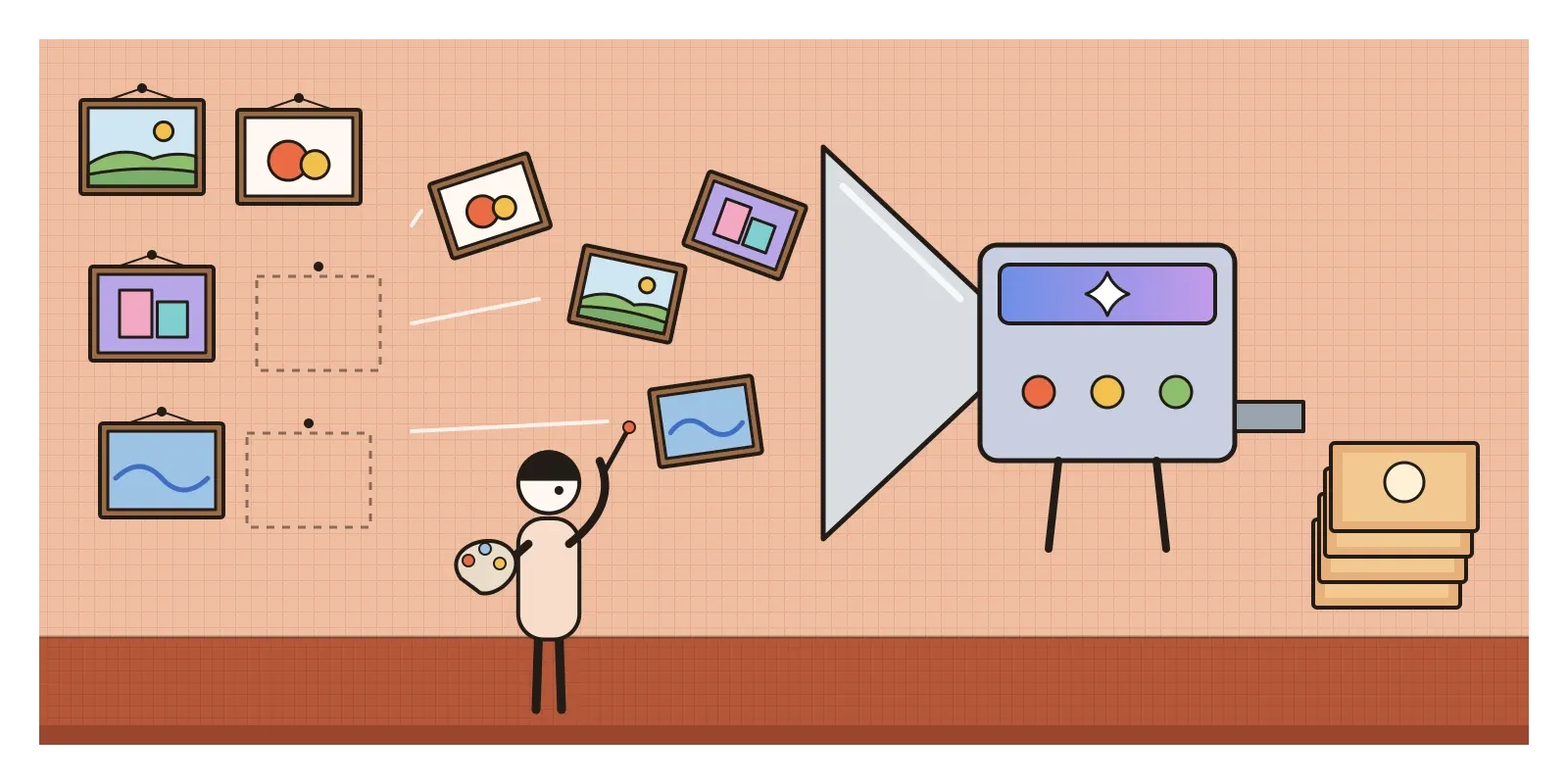
Work is the other half of the argument. Illustrators and concept artists have reported losing commissions, and in 2023 the striking Hollywood screenwriters won limits on how studios can use AI in their scripts. Underneath the polished images is the labelling and filtering done by people often paid very little, like the Kenyan workers who, Time reported in 2023, had been paid less than two dollars an hour to label harmful content. And the models use a great deal of electricity and water, which, as I wrote in the post on sustainable and regenerative design, is now a design question too.
AI aesthetics hasn't ended, and its replies are still forming: the return to the handmade, labelling rules, licensed training sets and artists who train small models on their own work. In the next post, on Vaporwave, we step back a decade to an earlier internet style that also built itself out of other people's images, but did it with a wink.
Prompt the same thing ten times
To see AI aesthetics clearly this week, try an experiment. Give any image generator the same short prompt ten times, something ordinary like "a tea stall in the rain", and lay the results side by side. Notice what stays the same: the light, the camera angle, the faces, the mood. That repetition is the style.
For an exercise, draw something by hand first, badly if you like, then generate the same thing, and write down every choice the drawing forced you to make that the prompt didn't. That list is a fairly good definition of craft. For reading, Kate Crawford's Atlas of AI covers the human and material costs behind the models, and Ted Chiang's essay for The New Yorker makes the strongest case that prompting isn't making art.
Jason Allen's blue ribbon is still argued over. Some people see it as the moment a new medium arrived, the way photography once forced its way into the salons, and others as the moment painters' work was quietly taken from them. And if the court agrees with the Copyright Office, the prize-winning picture belongs to nobody at all.
Further reading: Kate Crawford, Atlas of AI (2021) · Joanna Zylinska, AI Art: Machine Visions and Warped Dreams (2020) · Mary L. Gray and Siddharth Suri, Ghost Work (2019) · Ted Chiang, "Why A.I. Isn't Going to Make Art", The New Yorker (2024) · Arthur I. Miller, The Artist in the Machine (2019)
A reply toThe stock photograph, and the long hours of skilled work a convincing image used to need.