Visual Journaling
Why a small notebook, filled a little every day, trains your eye better than any single drawing.
Visual Journaling
A kitchen full of ordinary things
In 1995, Danny Gregory was working in advertising in New York, with a young son at home, when his wife Patti was badly injured in an accident on the subway and left paralysed from the waist down. In the months that followed, he felt helpless and frightened, and he did something he hadn't done since childhood. He started to draw. He didn't draw anything grand. He drew the things around him, the objects in his kitchen, things in the apartment, people and buildings in his neighbourhood, one page at a time in a sketchbook. He later wrote that the drawing slowed him down enough to notice the world again, and that ordinary things he'd walked past for years began to look interesting, even beautiful. Those pages became a book, Everyday Matters: A New York Diary, published in 2003, and they started him on a second career teaching other people to draw in the same way.
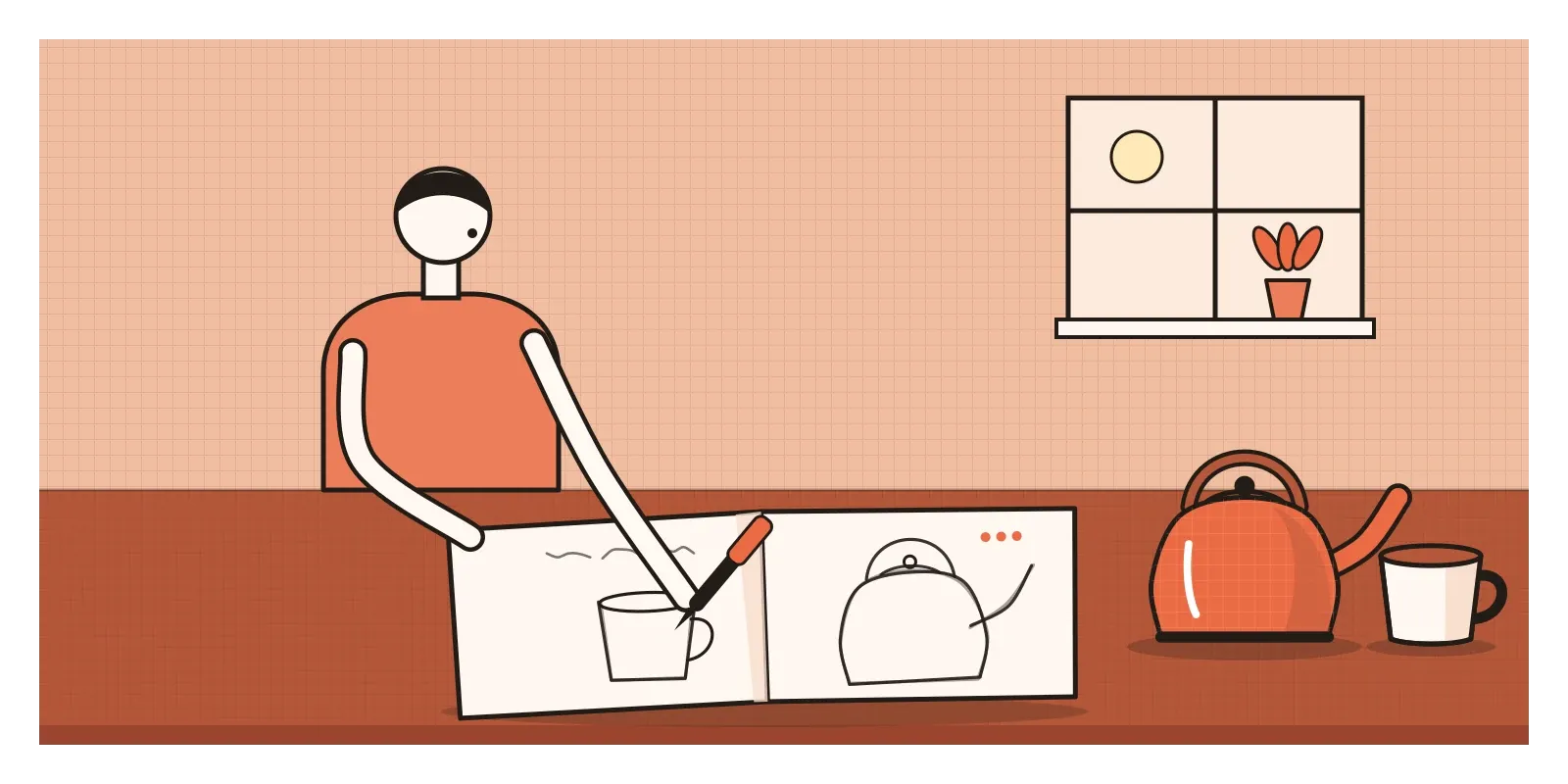
What strikes me about Gregory's story is how little of it is about talent. His early drawings were wobbly and unsure, like most people's. What mattered was that he kept going, a page a day, and that the pages built up into a record of how he was seeing. In the last post, on sketching as thinking, I wrote about drawing to find an idea. Visual journaling is its quieter companion. It's the habit of keeping a notebook where you regularly draw, write and collect what you notice, not for a project and not for anyone else, but to train your attention. The single drawings don't matter much. The habit does.
What a visual journal actually is
A visual journal is easiest to understand by comparing it with things it isn't. A project sketchbook is full of ideas for one particular job, a logo, a chair, a screen, and it's usually abandoned when the job ends. A diary records events and feelings in words. A visual journal sits somewhere between the two. It's dated, regular and personal like a diary, but its main language is drawing, mixed freely with handwriting, arrows, colour swatches and anything flat enough to stick in, like a ticket, a label or a pressed leaf. Most importantly, it's about what you saw today, not what you're designing.
The habit is old. Renaissance scholars kept commonplace books, notebooks where they copied out passages, facts and ideas worth keeping. Naturalists took the idea outdoors. Charles Darwin filled small field notebooks during the voyage of HMS Beagle from 1831 to 1836, and he kept writing in notebooks afterwards. In one of them, known as Notebook B, he drew a small, scratchy branching diagram in 1837 and wrote two words above it, "I think". It's often described as his first sketch of an evolutionary tree. As a drawing, it's nothing special. As a record of a mind noticing a pattern, it's one of the most famous pages in the history of science.
In recent decades, the habit has become a movement. In 2007, Gabriel Campanario, an illustrator and journalist at The Seattle Times, started an online group called Urban Sketchers, where people posted drawings made on location in their own cities. It grew into a non-profit organisation with chapters all over the world, including several in Indian cities. Its manifesto begins with the idea that sketchers draw on location, from direct observation, and that each drawing is a record of a time and place. That last part is what turns a sketchbook into a journal. You date the page, you note where you were, and over time the book becomes a history of your own looking.
There are writing versions of the habit too. The writer Julia Cameron, in her 1992 book The Artist's Way, recommended "morning pages", three pages of handwriting every morning, written without stopping or judging. Many people combine the two. There's no correct format. The only rule that really matters is regularity, a little, often, rather than a lot, occasionally.
Why drawing something helps you remember it
There's good evidence that drawing changes how well we remember things. In 2016, the psychologists Jeffrey Wammes, Melissa Meade and Myra Fernandes at the University of Waterloo published a series of experiments in which people were shown simple words, like "apple", and asked either to write each word out several times or to draw a picture of it, with the same amount of time for each. Later, without warning, they were asked to recall as many words as they could. People remembered considerably more of the words they had drawn, and the effect held up across many versions of the experiment. The researchers called it the drawing effect. Their explanation is that drawing makes you do several things at once. You have to think about what the thing means, decide what it looks like, and move your hand to make it, and each of those leaves its own trace in memory.
Even doodling seems to help. In a study published in the journal Applied Cognitive Psychology, the psychologist Jackie Andrade at the University of Plymouth asked people to listen to a long, dull phone message about a party. Half of them were asked to shade in shapes on a sheet of paper while they listened. Afterwards, the doodlers remembered noticeably more of the message, around 29 percent more. Andrade's suggestion was that a simple doodle keeps the mind from drifting into daydreams, which uses up more attention than the doodling does.
This helps explain something people who keep visual journals often say: they remember the places they drew far better than the places they photographed. A photograph takes a fraction of a second. A drawing of the same street corner might take fifteen minutes, and in that time you notice the angle of the awning, the man selling chai at the corner, the way the light falls across one wall but not the other. As I wrote in the post on observational drawing, drawing is mostly a way of training the eyes. A journal simply makes that training a daily routine.
The designer Mike Rohde made a related habit popular among people who work in technology. In The Sketchnote Handbook, published in 2012, he describes sketchnotes, notes taken during talks and meetings that mix handwriting, simple drawings, arrows and boxes. Deciding how to draw an idea forces you to listen for what it actually means, which is exactly the work the drawing effect relies on.
A boy, a blank book and the crowds of Goa
One of India's most loved artists began, by most accounts, with a visual journal. Mario Miranda was born in 1926 and grew up in Loutolim, a village in Goa. The story often told about his childhood is that he drew on the walls of the family home, and that his mother gave him blank books to draw in instead. He filled them with drawings of family life, neighbours and village scenes, keeping them almost like illustrated diaries. He went on to become one of the country's best-known cartoonists, working for publications of the Times of India group in Bombay, including The Illustrated Weekly of India, and his murals still cover the walls of Café Mondegar in Colaba, Mumbai.
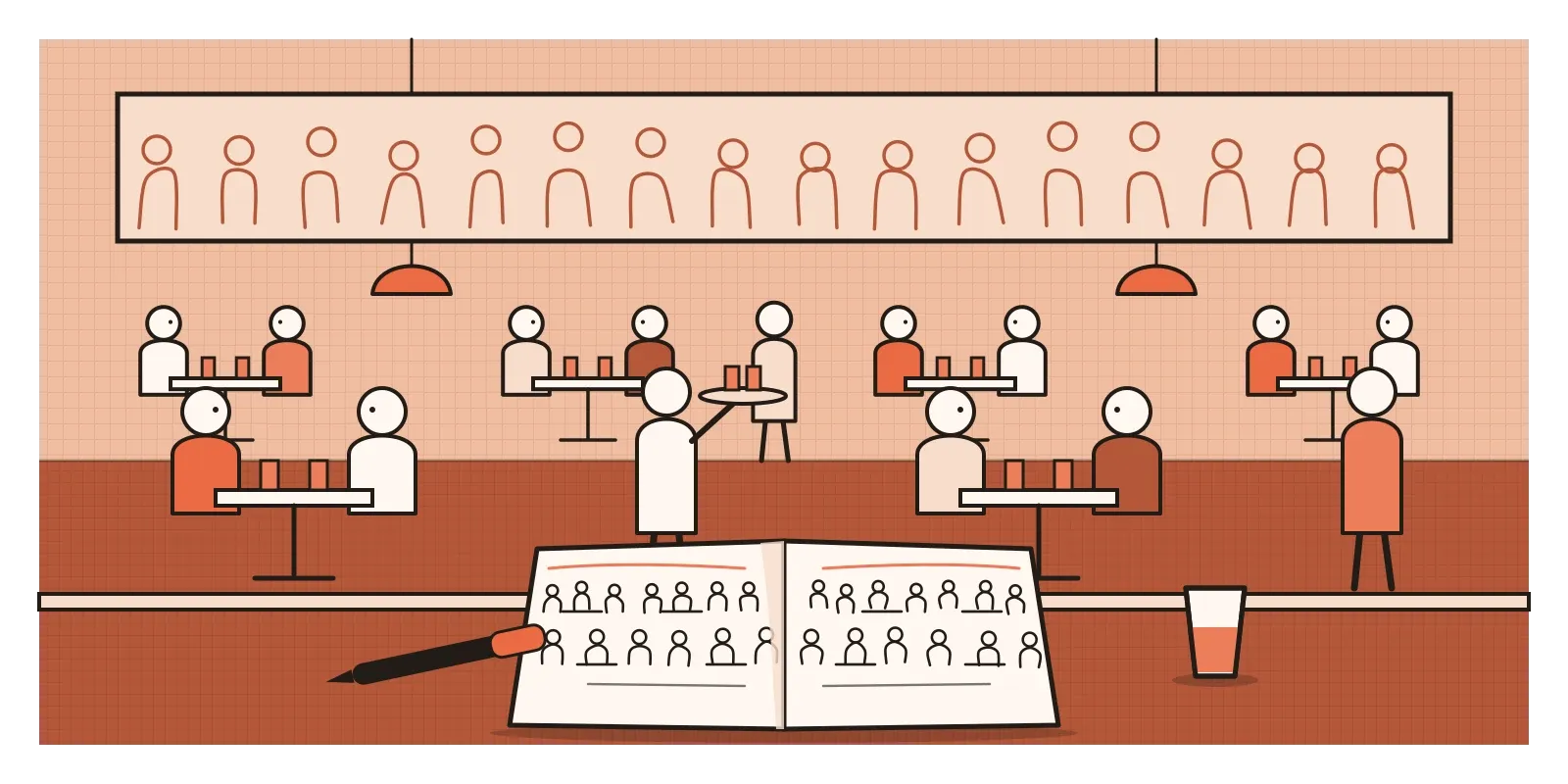
What makes his work feel like journaling is the observation underneath it. Miranda's best-known drawings are huge, crowded scenes, a village feast, a church festival, a busy office, a Bombay street, packed with dozens of small figures, each doing something particular: gossiping, dozing, bargaining, sneaking a second helping. Nobody could invent that much detail from scratch. It comes from years of sitting in cafés and markets and drawing what people actually do. His drawings are now treated as a kind of social history of Goa and Bombay in the second half of the twentieth century, and he was awarded the Padma Vibhushan after his death in 2011.
His work is also a reminder that no journal is neutral. Miranda's crowds are affectionate caricature, and some of his recurring figures, the pompous boss or the glamorous secretary, rely on types rather than individuals. A visual journal records what its keeper chooses to see and how they see it. That's part of its value. Looking back through your own pages will show you not only what was in front of you, but what you tend to notice and what you tend to leave out.
A journal for the screens you use every day
Designers who work on screens sometimes assume a visual journal is for illustrators and architects, not for them. I think it's just as useful for interface work, with one adjustment. Alongside streets and cups and people on the bus, draw the screens you use. When an app does something that makes you pause, a clever empty state, a confusing settings page, a payment flow that went smoothly at a busy counter, draw it in your journal, roughly, from memory or with the phone beside you. Add arrows for what happened when you tapped, and a line or two about where you were and what you were trying to do.
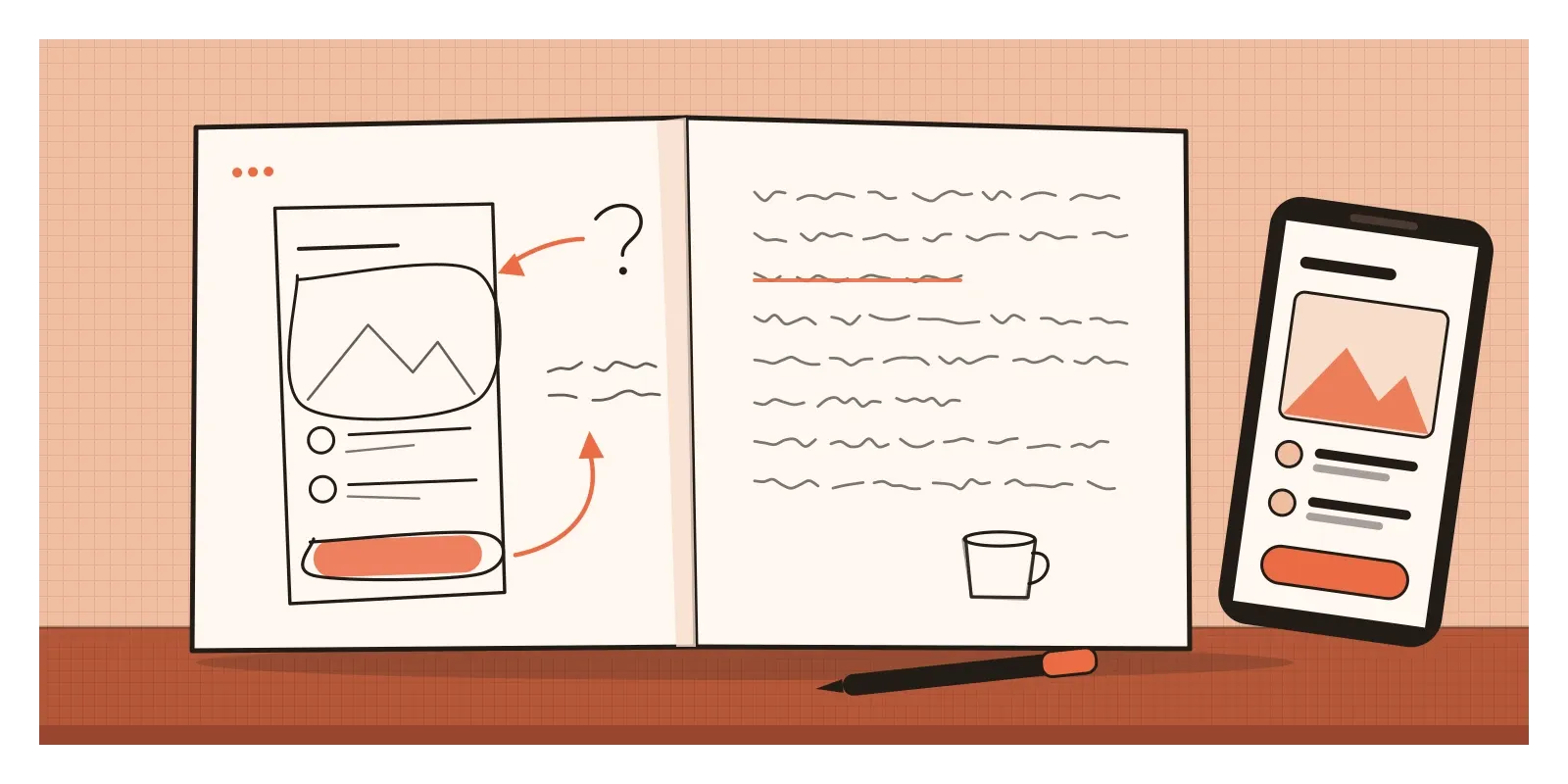
Most designers already collect screenshots. Advertising people had an older name for this, a swipe file, a collection of other people's work kept for inspiration. Screenshots are useful, but they're passive. You can save a hundred in a minute without really looking at any of them. Drawing a screen, even badly, forces you to notice how it's built: which element is largest, how much space sits between groups, what the eye lands on first, all the things I wrote about in the posts on hierarchy and space. You also capture something a screenshot never does, which is the context. A screenshot of a ticket-booking app looks the same whether you used it calmly at home or in a panic at a railway station with a train about to leave. Your note about the panic is the useful part.
The same goes for AI tools. They can produce endless polished images in seconds, and that makes a record of your own eye more valuable, not less. A journal is a slowly growing collection of what you, specifically, found interesting, odd or broken. Later in this series, in the post on mood boards, I'll write about turning collected images into a visual direction for a project. A journal is the raw material that sits underneath that, gathered long before any particular project asks for it.
One page a day, for one week
If there's one thing I'd take from this, it's that the value of a visual journal comes from repetition, not from any single page. A brilliant drawing made once teaches you less than a hundred ordinary ones made over a few months. So make it easy. Choose a small notebook that fits in a bag or pocket, use a pen so you can't erase, and lower your standards on purpose. A page doesn't need to look good. It needs to exist.
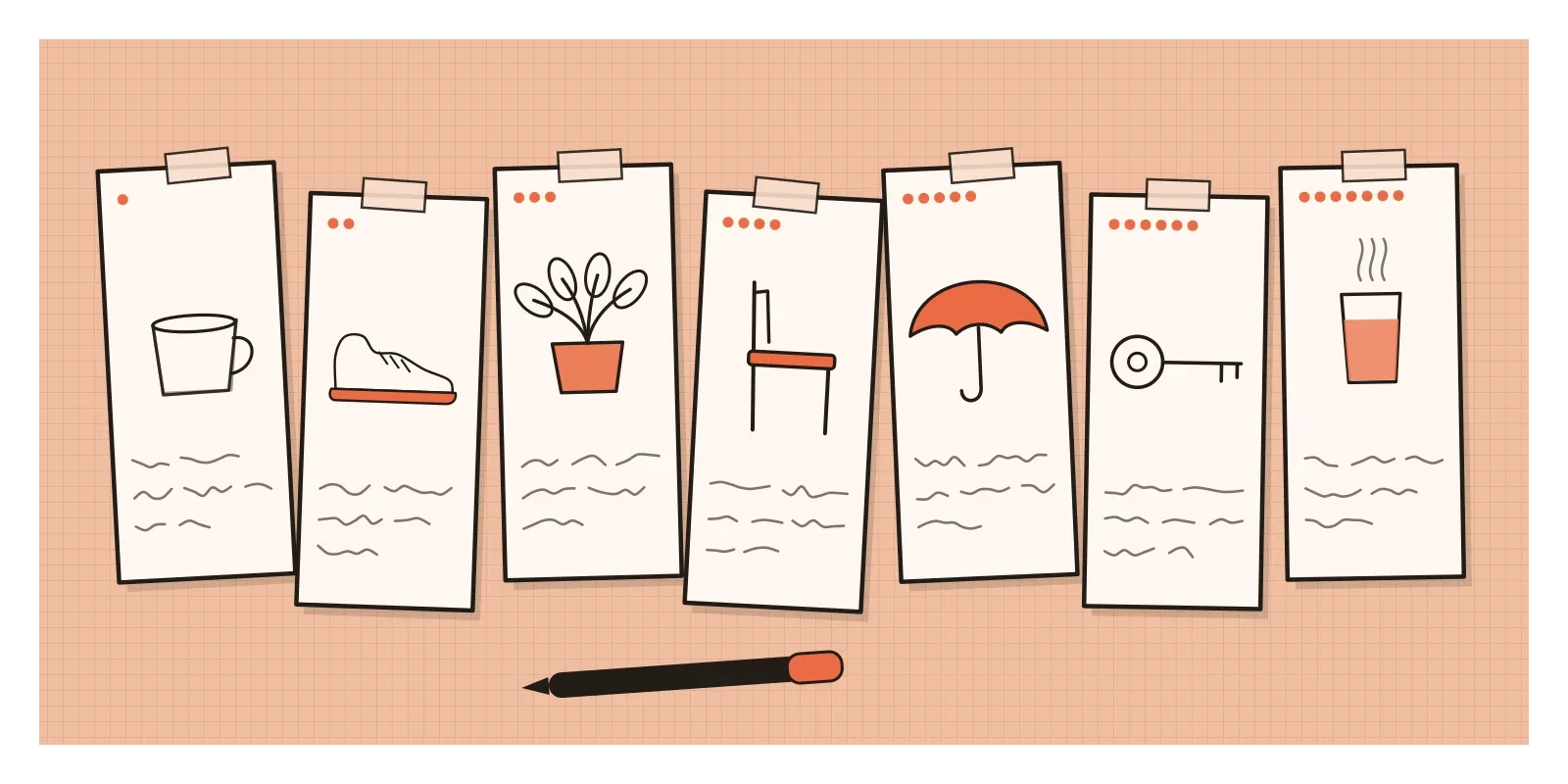
Here's a small exercise for this week. For seven days, fill one page a day in ten minutes or less. Write the date and where you are at the top. Draw one ordinary object from life, a cup, a shoe, a plant, a chair on the other side of the room. Then draw one screen you used that day, from memory, with an arrow and a note about what happened. Finish with a single sentence about something you noticed and wouldn't otherwise have mentioned. At the end of the week, lay the pages side by side and look at them together. You'll probably find your drawings got a little looser, and that you started noticing things during the day because you knew you'd want to draw them later. In the next post, on how the eye sees, I'll look at why that kind of noticing takes effort at all.
Danny Gregory didn't set out to become an artist. He set out to get through a hard year, and he did it by drawing the ordinary things around his home and his street, one page at a time. Looking back, the pages weren't really about those objects. They were a record of someone learning to pay attention again, and that's what any visual journal ends up being.
Further reading: Danny Gregory, Everyday Matters: A New York Diary (2003) · Jeffrey Wammes, Melissa Meade and Myra Fernandes, "The drawing effect: Evidence for reliable and robust memory benefits in free recall" (2016) · Jackie Andrade, "What does doodling do?" (2010) · Mike Rohde, The Sketchnote Handbook (2012) · Gabriel Campanario, The Art of Urban Sketching (2012)