Rasa Theory
An old Indian theory of theatre that explains how a made thing produces a feeling in the person meeting it.
Rasa Theory
Nine boxes taped on a studio floor
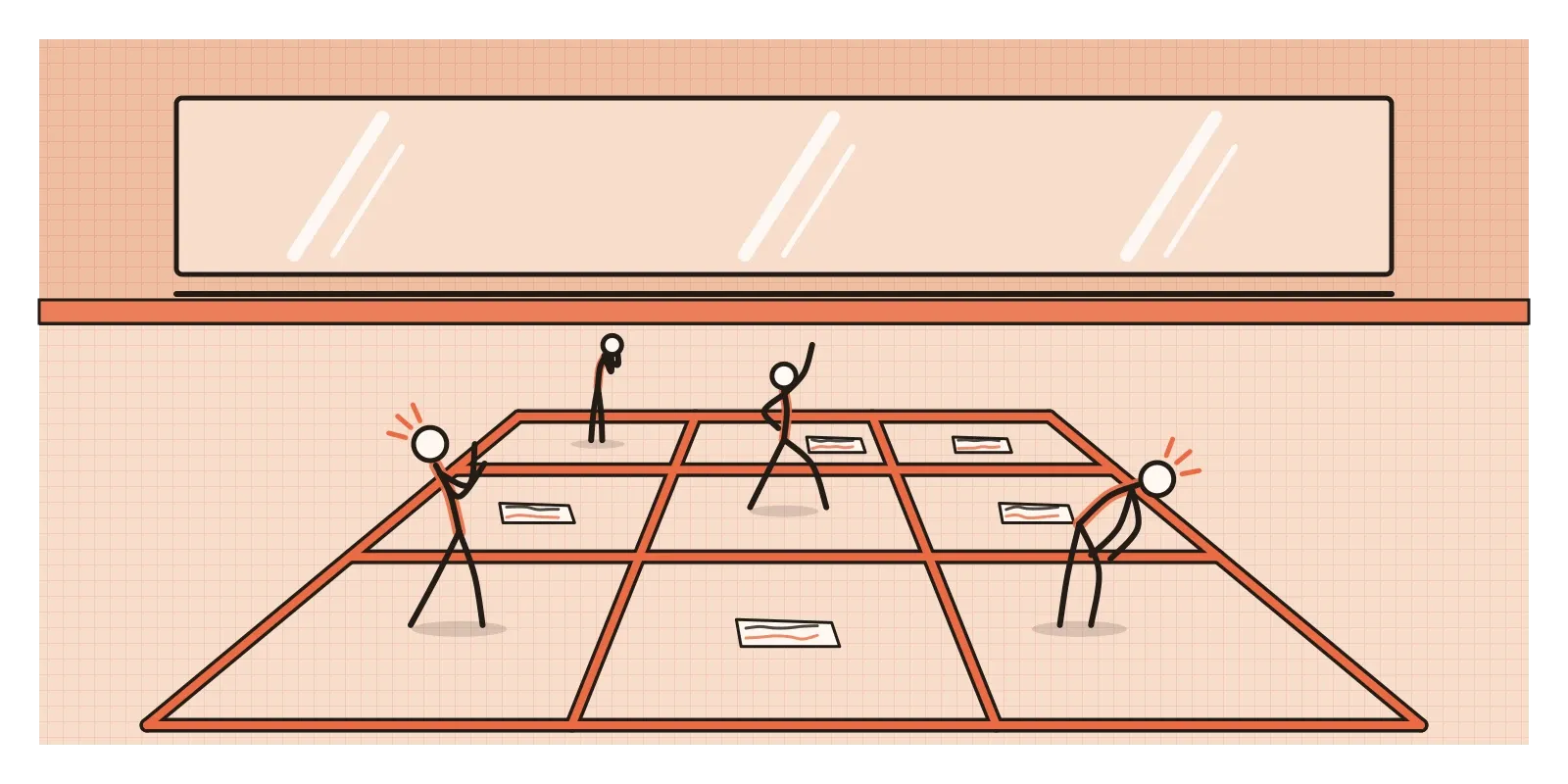
In the 1990s, the American theatre director Richard Schechner, a professor at New York University, began developing an unusual exercise for actors. The floor of a studio is marked out with tape into a grid of nine large boxes, three by three, and each box is given the name of an emotion in Sanskrit. First, the actors walk around the grid and fill each box with whatever the word brings to mind, scribbled words, drawings, scraps of memory, without discussing what it is supposed to mean. Then they step inside. In one box they have to become fury with their whole body and voice, in the next, terror, in the next, helpless laughter, moving from box to box until switching from one feeling to another becomes almost physical. Schechner called the exercise Rasaboxes, and in 2001 he described it in an essay called "Rasaesthetics" in TDR: The Drama Review. Versions of it are still taught in acting schools in several countries.
The nine words on that floor weren't Schechner's invention. They came from rasa theory, one of the oldest and most carefully argued theories of art anywhere in the world, worked out in India across more than a thousand years. Rasa is a Sanskrit word for sap, juice, essence or flavour, the taste of something. Applied to art, it names the particular kind of feeling an audience relishes when a play, a dance, a poem or a song works. I wanted to begin the last three posts of this section, a short series on Indian aesthetics, with rasa, because it asks a question that every designer eventually has to answer. Not what a thing looks like, but how it makes the person meeting it feel, and how that feeling is actually produced.
A handbook for the whole theatre
The earliest surviving account of rasa is in the Natyashastra, a vast Sanskrit treatise on drama attributed to a sage called Bharata. Almost everything about its origins is uncertain. Scholars have dated it anywhere from a few centuries before the Common Era to a few centuries after, and many think the text we have was compiled and expanded over a long period, probably by more than one hand. Bharata himself may be partly legendary, and in later usage the word bharata could simply mean an actor. What is certain is the scale of the work. It runs to around six thousand verses and covers nearly everything a theatre company would need: how to build a playhouse, the meanings of hand gestures and glances, music, costume, make-up and even how to judge a performance.
The text opens with an origin story. The gods, it says, asked the creator Brahma for an entertainment that could be both seen and heard, and that everyone could share, since the Vedas could not be heard by all. Brahma made a fifth Veda, taking recitation from the Rigveda, song from the Samaveda, acting from the Yajurveda and rasa from the Atharvaveda. Read as a design brief, it's remarkably modern: something assembled from several media, made for a mixed public, with feeling as a core ingredient.
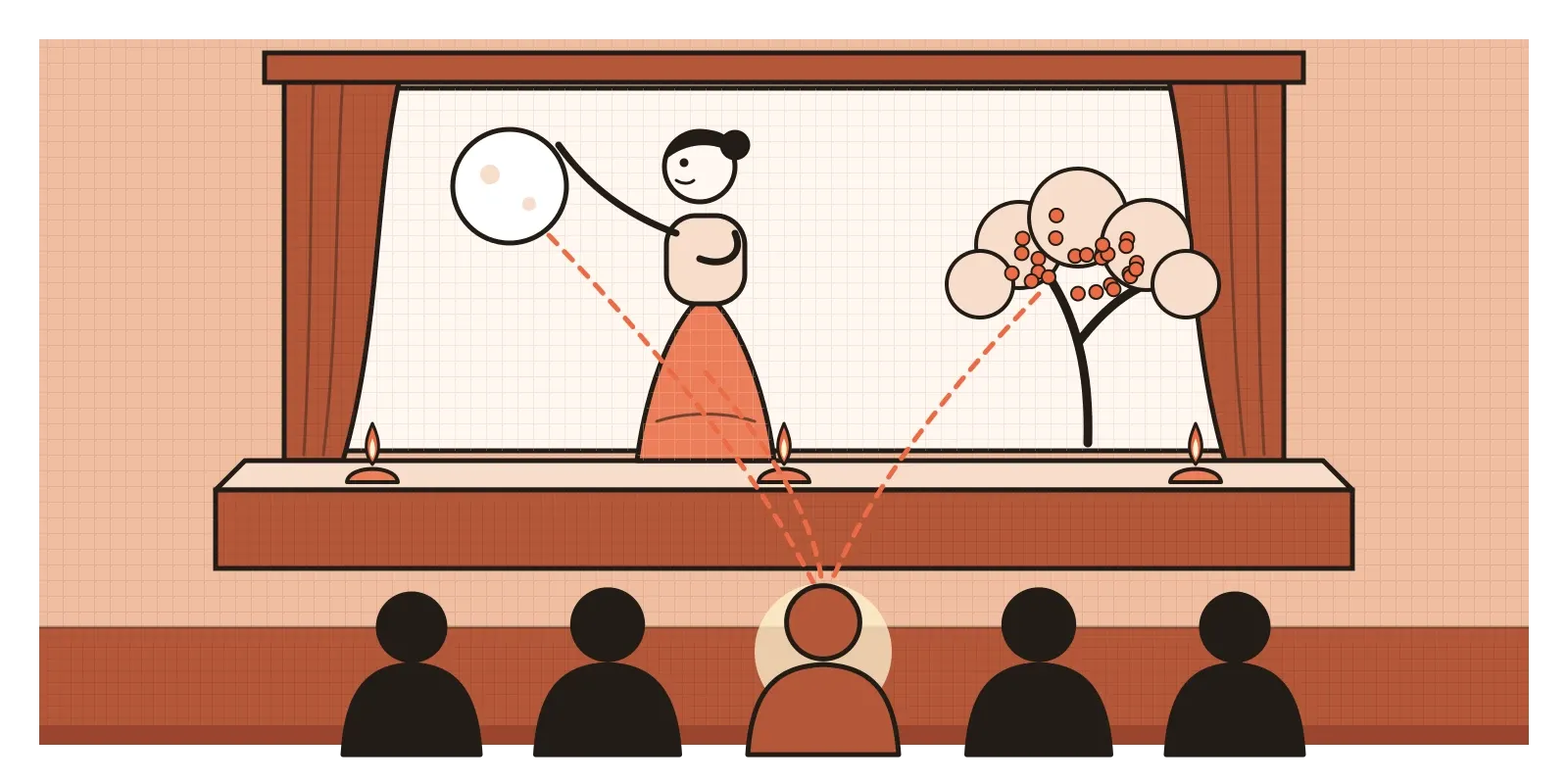
The key idea arrives in the sixth chapter, in a single compressed sentence that commentators have argued over ever since. Rasa, it says, arises from the combination of determinants, consequents and transitory states. To explain what that means, the text reaches for food. Just as people of taste, eating a dish prepared with many spices and condiments, relish its flavour and feel pleasure, so cultured spectators relish the stable emotions when they are brought out by the many elements of a performance. The analogy is the whole theory in miniature. Nobody tastes cumin, salt and tamarind separately in a good dish. They taste one flavour that none of the ingredients has on its own.
Ingredients, reactions and passing moods
The ingredients have names. The determinants, called vibhava, are the causes of a feeling: the characters, the situation and the setting. Later writers divided them into the person or thing the emotion is about and the circumstances that intensify it, such as moonlight, a garden in spring or the sound of rain for lovers who are apart. The consequents, called anubhava, are the visible signs that someone is feeling something: a glance, a gesture, a change in the voice, a hand pressed to the chest. The transitory states, vyabhicharibhava, are the passing moods that flicker across a stronger emotion, and Bharata lists thirty-three of them, including anxiety, weariness, joy, envy, recollection and doubt. He also lists eight involuntary states an actor must suggest, such as trembling, tears and a voice that breaks.
Underneath sit eight stable emotions, the sthayibhava, which everyone carries: love, mirth, sorrow, anger, energy, fear, disgust and astonishment. When a performance combines its ingredients well, each stable emotion becomes a rasa that the audience can savour. Love becomes shringara, the romantic or erotic rasa. Mirth becomes hasya, the comic. Sorrow becomes karuna, the compassionate. Anger becomes raudra, the furious. Energy becomes vira, the heroic. Fear becomes bhayanaka, the terrible. Disgust becomes bibhatsa, the odious. Astonishment becomes adbhuta, the marvellous. The Natyashastra even gives each rasa a colour and a presiding deity. Shringara is a dark blue-black, raudra is red, hasya is white and adbhuta is yellow.
What I find most useful is the distinction between an emotion and its rasa. Real anger is unpleasant and narrows your attention. The furious rasa in a well-made performance is something you enjoy, even as your heart races. In the post on mood boards, I wrote about Ragamala paintings, where each musical mode is given a scene. Rasa theory explains why such things work at all. A feeling can be built from parts, and the built feeling is not the same as the raw one.
Whose feeling is it?
If the audience is relishing sorrow, whose sorrow is it? The actor's? The character's? Their own? Indian thinkers argued about this for centuries, and much of what we know about the early debate comes from one remarkable writer. Abhinavagupta, a philosopher who lived in Kashmir around the late tenth and early eleventh centuries, wrote a long commentary on the Natyashastra called the Abhinavabharati. In it he summarised, and usually disagreed with, the commentators before him, whose own works are mostly lost. One, Bhatta Lollata, seems to have thought rasa was the emotion of the original character, intensified on stage. Another, Shri Shankuka, compared the audience to someone looking at a painting of a horse, who knows it isn't a horse and still recognises one. A third, Bhatta Nayaka, argued that drama strips feelings of their personal ties so that everyone can share them.
Abhinavagupta took that last idea, usually called sadharanikarana, generalisation, and built on it. In his account, a good performance loosens the knot of "mine" and "not mine". You don't feel Rama's grief as Rama, and you don't feel it as your own private loss. You feel grief as such, freed from self-interest, and because it's freed, you can taste it rather than suffer it. That's why, he argued, people willingly watch tragedies. He also insisted that this tasting needs a prepared spectator, a sahridaya, literally a person whose heart is in tune, someone with enough experience and sensitivity to respond, much like the rasikas I mentioned in the post on critique. Rasa isn't sitting inside the play like a coin in a box. It happens in the meeting between a well-made work and a receptive person.
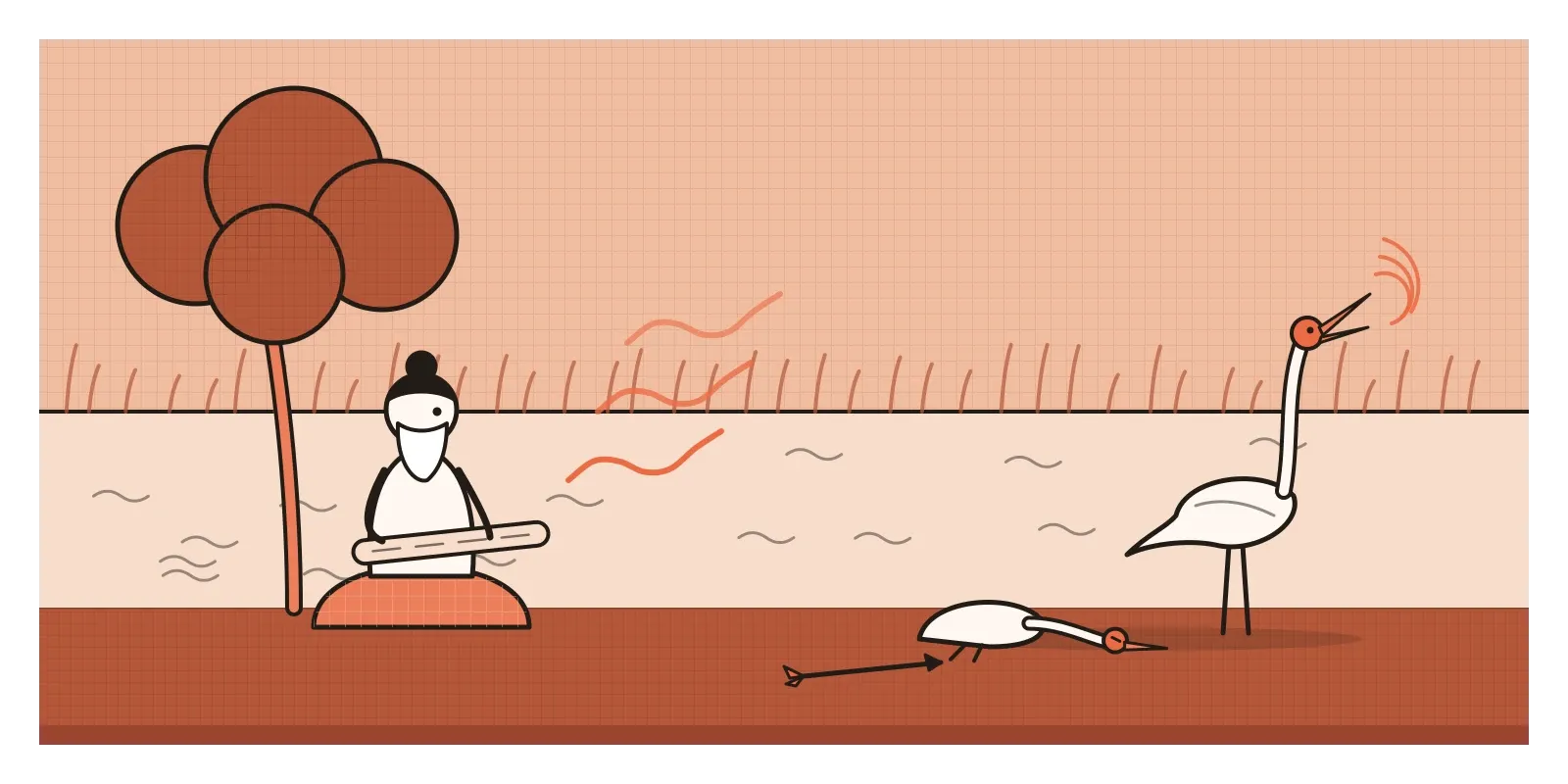
The tradition has a favourite story about where this kind of feeling comes from. In the opening book of the Ramayana, the sage Valmiki is walking by the river Tamasa when a hunter shoots one of a pair of krauncha birds, and its mate cries out. Valmiki's grief spills out as a curse in a new metre, and the tradition remembers this as the birth of poetry: shoka, sorrow, became shloka, verse. It's a legend, not history, but in the ninth century the Kashmiri critic Anandavardhana used it to argue that rasa, here the compassionate rasa, is the soul of poetry.
The list itself didn't stay fixed either. The famous number nine, as in navarasa, comes from a ninth rasa, shanta, peace or tranquillity, that isn't part of Bharata's original eight. Later writers argued over whether calm detachment could be dramatised at all. Anandavardhana thought the whole Mahabharata was ultimately about it, and Abhinavagupta defended it at length, which helped it become standard. Others went further. In the sixteenth century, the Bengali theologian Rupa Gosvami built an entire theory of devotion as a rasa, and some writers argued for a rasa of parental tenderness. Rasa was never one fixed doctrine. It was a long, lively conversation.
Every screen has a dominant feeling
Product designers usually talk about feeling through Western frameworks. Don Norman's 2004 book Emotional Design describes three levels at which we respond to things: visceral, the instant gut reaction to how something looks and feels, behavioural, the pleasure or frustration of using it, and reflective, what it means to us afterwards. The psychologist Paul Ekman's basic emotions from the 1970s, anger, disgust, fear, happiness, sadness and surprise, overlap strikingly with Bharata's stable emotions. Ekman's claim that they show the same way on every face has since been strongly challenged, which matters for AI tools that claim to read feelings from faces. Rasa theory would have been suspicious from the start, because it locates feeling in the meeting between a work and a person, not in a face.
Where rasa theory adds something is in its craft vocabulary. Later theorists said that a work should have one principal rasa, with others supporting it, and that some rasas clash. Comedy in the middle of grief has to be handled with great care, or it breaks the spell. That's a useful lens for interfaces. A meditation app is built around shanta, so its slow animations, soft colours and absence of badges all serve one feeling. A game might be built around vira, with every sound and screen pushing energy. Trouble starts when the rasas clash, like a cheerful joke on the screen that tells you a payment has failed, or when a product deliberately manufactures bhayanaka. Countdown timers, "only two left" warnings and guilt-laden opt-out buttons are what the designer Harry Brignull called dark patterns. In rasa terms, they're determinants arranged to produce fear, and the feeling is real rather than relished, which is exactly the line good art isn't supposed to cross.

The vocabulary maps neatly onto the work. The determinants are the context and content you design, the copy, the imagery, the moment in someone's day when they open the app. The consequents are the visible signs in the interface itself, the bounce of a confirmation, the pause before a result appears. The transitory states are the small moods along a journey, a flicker of doubt at a form, relief at a saved draft. And the sahridaya is your user, who brings their own experience and culture. You can arrange everything perfectly and still fail if you haven't understood the person on the other side, which is why it pays to watch real people use what you've made, and to invite the kind of critique I wrote about in the last post.
Choose the rasa before the colours
Rasa theory began as advice for actors and playwrights, but its lesson travels well. Feelings in a designed thing don't come from one decision. They come from many small ones, setting, signs and passing moods, combined so carefully that people experience a single flavour. And that flavour depends as much on the person receiving it as on the thing being made.
If you want to try it, take one screen or product you're working on and decide its principal rasa in a single word before you change anything. Then list its determinants, its consequents and the transitory moods someone might pass through while using it, and look for anything that clashes with the main feeling. For a more physical version, borrow Schechner's idea. Draw a grid of nine boxes across two pages of your sketchbook, write one rasa in each, and over a week fill the boxes with images, colours, sounds and textures that carry that feeling. It's a mood board organised by emotion rather than style.
Schechner's actors learned to step from fury to terror in seconds, but what made it work was the slow part first, filling each box until the word meant something. Design is like that too. In the next post, on Indian aesthetic concepts, I'll look at a word that has often been misread as decoration, alankara, and at what Indian traditions meant by ornament and beauty.
Further reading: Sheldon Pollock (trans. and ed.), A Rasa Reader: Classical Indian Aesthetics (2016) · Richard Schechner, "Rasaesthetics" (2001) · Daniel H. H. Ingalls, Jeffrey Moussaieff Masson and M. V. Patwardhan (trans.), The Dhvanyaloka of Anandavardhana with the Locana of Abhinavagupta (1990) · Susan L. Schwartz, Rasa: Performing the Divine in India (2004) · Don Norman, Emotional Design (2004)