Indian Aesthetic Concepts
What alankara, auchitya and the six limbs of painting say about ornament, fitness and beauty.
Indian Aesthetic Concepts
The most admired decoration in London came from India
In the summer of 1851, millions of people visited the Great Exhibition in London, housed in the Crystal Palace, a vast greenhouse of iron and glass in Hyde Park. Britain meant it as a showcase of industrial power, and its own manufacturers filled the halls with machine-made goods. Some of the critics who mattered most came away unimpressed. Reformers such as the architect Owen Jones and the painter Richard Redgrave complained that British carpets were covered in shaded, three-dimensional roses that looked as if you could trip over them, and wallpapers pretended to be gardens or architecture. Meanwhile, in the section given to India, they found textiles, carpets, metalwork and inlaid boxes whose patterns stayed flat, sat comfortably on the surface they decorated and were organised with remarkable clarity.
The admiration had consequences. Objects bought from the Exhibition went into a new Museum of Manufactures, which grew into what is now the Victoria and Albert Museum, partly so that British students could learn from them. In 1856, Jones published The Grammar of Ornament, a huge illustrated survey that held up Indian work as an example of ornament done right.
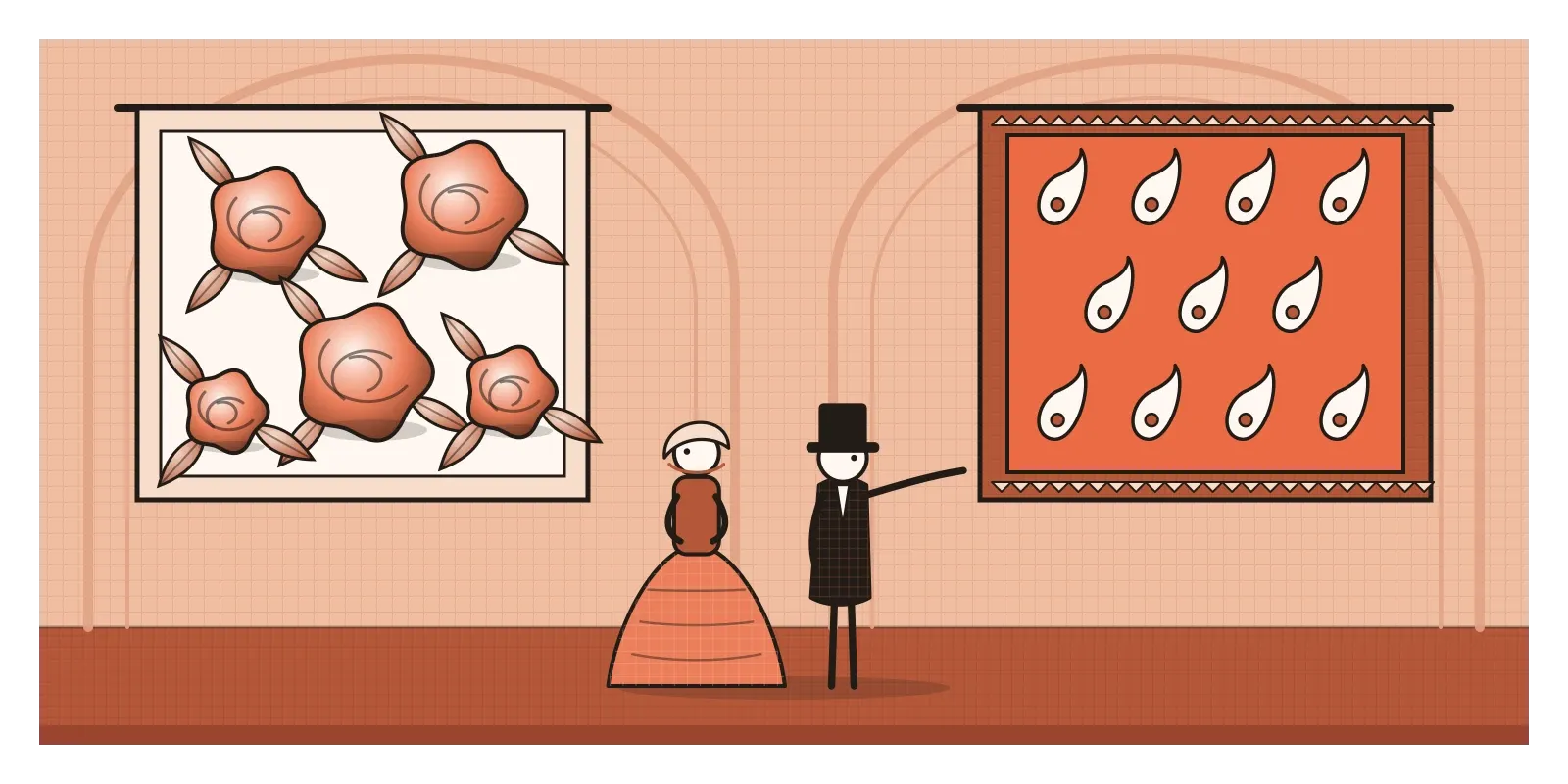
The story is flattering, and it's also more complicated than it sounds. The same empire that praised Indian craft in its museums was flooding Indian markets with cheap mill-made cloth, and British manufacturers studied Indian patterns partly to copy them by machine. The teardrop motif from Kashmir shawls, woven in imitation in a Scottish town, is still known in English by that town's name, paisley. The Victorians also understood Indian work through their own idea of ornament, as something added to a surface to make it pleasant to look at. Indian traditions had a richer vocabulary for these questions, and this post, the second in a short series on Indian aesthetics, is about three of its ideas: alankara, auchitya and the six limbs of painting.
Alankara: making a thing enough
The Sanskrit word usually translated as ornament is alankara, and its roots say something the English word doesn't. It joins alam, meaning enough, sufficient or fit, with kara, making. An alankara is literally something that makes a thing adequate, that completes it. In 1939, the scholar Ananda Coomaraswamy, whose ideas about art and craft I wrote about in the post on design, art and craft, published a short essay in The Art Bulletin simply called "Ornament". He traced words for ornament in Sanskrit and other old languages and argued that most of them originally meant equipping or completing something, not prettifying it. An ornament, in that older sense, was part of what made a person or an object ready to do what it was meant to do.
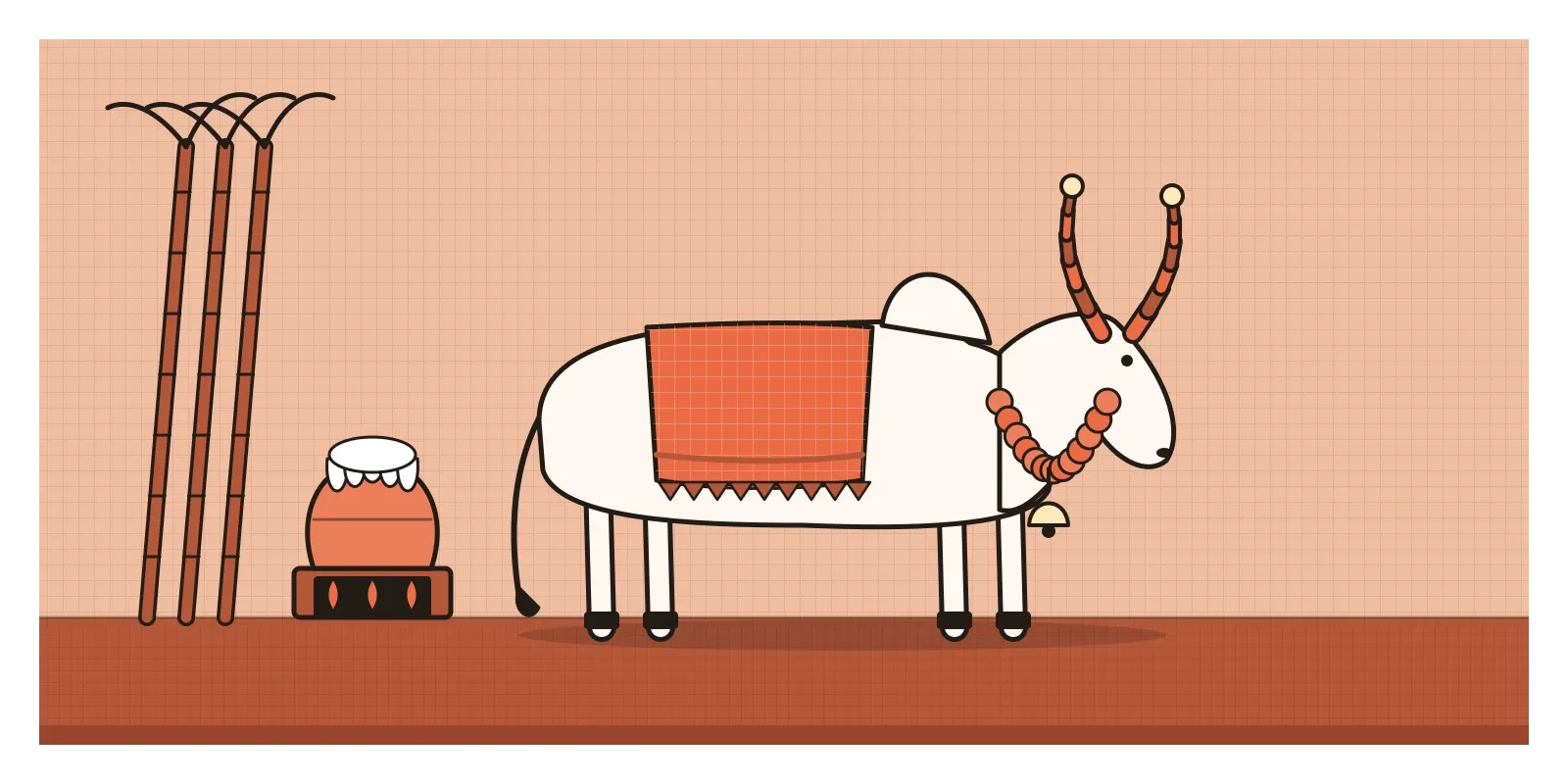
You can see that meaning in everyday Indian life. Jewellery has never been only about looks. A bride's adornments mark a change of status, a black-beaded necklace or toe rings can signal marriage in many communities, an amulet is worn for protection and gold doubles as savings a family can carry. During Mattu Pongal in Tamil Nadu, the day after the harvest festival of Pongal, farmers bathe their cattle, paint their horns in bright colours and hang bells and garlands around their necks. The decoration is a way of honouring animals the household depends on. Without it, the festival wouldn't be complete.
It's worth being careful here. Coomaraswamy was making an argument as well as describing a tradition, and later scholars have criticised him for presenting an idealised, timeless India in which everything was meaningful and nothing was merely fashionable. Indian courts loved luxury and display as much as any others, and plenty of ornament was about wealth and showing off. But the etymology still points to a useful question, and I find it a better one than "is this decoration necessary?" The better question is what the ornament completes.
In poetry, ornament had to answer to feeling
In Sanskrit literary theory, alankara had a second, more technical meaning. It referred to figures of speech: upama, simile, rupaka, metaphor, shlesha, the pun, and dozens of others. The study of poetics itself was often called alankarashastra, the science of ornament. Early theorists such as Bhamaha and Dandin, both writing around the seventh century, catalogued these figures in detail. Dandin defined alankaras as the qualities that make poetry beautiful, and in the eighth century the Kashmiri critic Vamana went further, declaring that poetry is enjoyed because of its ornament, and that ornament simply is beauty.
Then came a long argument about what really mattered, which Sanskrit critics framed as a search for the soul of poetry. Vamana thought it was style. In the ninth century, Anandavardhana, whom I mentioned in the post on rasa theory, argued that it was dhvani, suggestion, the meaning a poem evokes without stating, and above all the rasa it suggests. Figures of speech still mattered, but they were demoted. In his view they were like bracelets and earrings on a body, lovely, but not what makes it alive. An ornament that served the feeling was right. One that drew attention to itself at the feeling's expense was a mistake.
In the eleventh century, the poet and critic Kshemendra added the idea I find most useful for design: auchitya, appropriateness or fitness. Every element of a poem, a word, a figure, a metre, a rasa, has to suit its context. He made the point with jewellery, asking, in effect, who wouldn't look ridiculous wearing a waist chain around the neck or a necklace around the hips. The ornaments are fine. They're just in the wrong place. Long before design reviews existed, that was a precise description of most of what goes wrong with decoration.
Ornament that gathers at doorways and edges
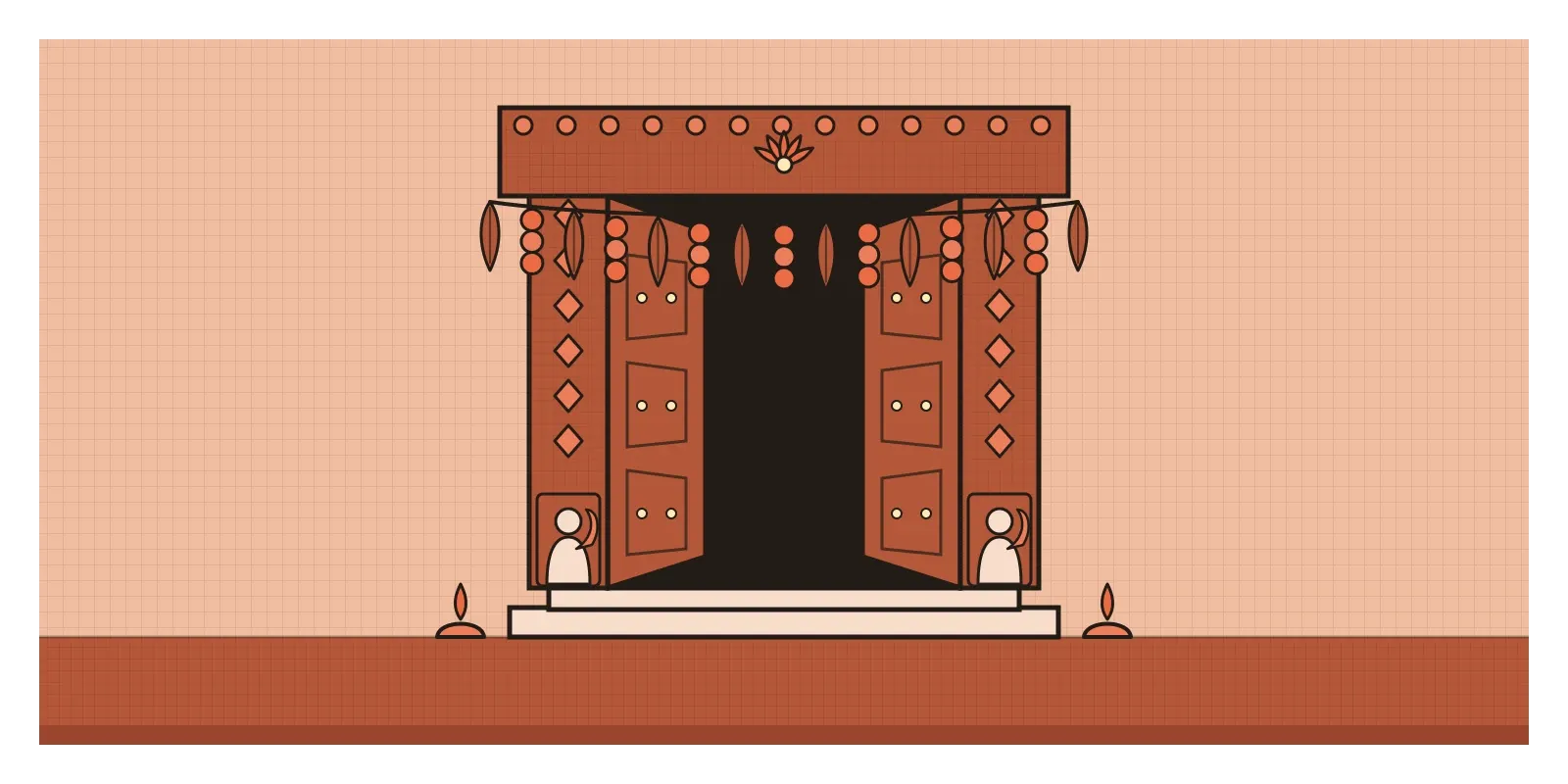
Look at where ornament sits on Indian buildings and objects and a pattern appears. It gathers at thresholds, borders and points of contact. Temple doorways are among the most heavily carved parts of many temples. From around the Gupta period onwards, figures of the river goddesses Ganga and Yamuna often flank the door, as if purifying anyone who passes, and the lintel above carries auspicious figures and motifs. At home, doors are hung with a toran of mango leaves or marigolds for festivals and weddings, and in parts of South India a fierce painted face is hung on a house under construction to ward off the evil eye.
Textiles work the same way. A sari often keeps its densest decoration for the border and the pallu, the end that falls over the shoulder, where the cloth is most seen and handled. The body of the sari may be plain or lightly patterned. The ornament marks the edges, the transitions and the places where a person meets the object, exactly where the eye and hand arrive. That's a habit of placement as much as of style, and it's a very practical one. The doorway is where you decide to enter. The border is where cloth begins and ends. Ornament there helps a thing announce itself and helps a person cross into it.
Beauty itself was described with a cluster of words rather than one. Saundarya is beauty in general. Shobha is splendour or radiance. Lavanya, usually translated as grace or charm, is related to the word for salt, the quality that makes something savoury rather than bland, which links it neatly back to the language of taste in rasa theory. And for painting, a famous verse lists six limbs, or shadanga: rupabheda, the distinction of forms, pramana, proportion and measure, bhava, feeling, lavanya yojanam, the infusion of grace, sadrishya, likeness, and varnikabhanga, the handling of colour and brush. The verse is found in a medieval commentary on the Kamasutra by Yashodhara, and how much older it is remains uncertain. It became well known in the early twentieth century through the painter Abanindranath Tagore, whose circle I'll come back to in a later post on movements. Read today, it's an excellent checklist. Grace is only one limb out of six, and it comes after form, proportion and feeling.
Ornament on a screen, and the question of fit
In the post on form follows function, I wrote about how phone interfaces swung from leather-stitched calendars to flat colour and thin type. Both sides were arguing about ornament without having good words for it. Sanskrit poetics offers a few. Alankara asks what a decorative element completes. Auchitya asks whether it fits this person, this moment and this place. Dhvani asks whether it suggests the right feeling without shouting.
Indian apps give these questions plenty of practice, because festivals matter and products like to join in. During Diwali, payment, shopping and food apps often add lamps, rangoli-like borders or fireworks to their screens. Done with auchitya, that might mean a small lamp beside the greeting at the top of the home screen or a warm border around an offers banner, ornament at the edges and thresholds, like a toran on a door. Done badly, sparkles drift across the button you need to press to pay your electricity bill, or a generic "Indian" pattern of paisleys and mandalas is pasted onto everything, regardless of where the user lives or what they celebrate. The ornaments are fine. They're just on the hips instead of the neck.

There's a well-known example of ornament at a digital threshold from outside India. Since 1998, when Google's founders put a small stick figure behind the second "o" of the logo to show they were away at the Burning Man festival, the Google Doodle has decorated the one element almost everyone sees first. Doodles change for anniversaries, festivals and national days in different countries, including Indian ones, while the search box underneath stays exactly where it is. It's alankara in the older sense, completing an occasion, placed at the doorway, and it never gets in the way of the job.
Ask what the ornament completes
The ideas in this post come from different centuries and different arts, but together they give designers a vocabulary that the plain-versus-decorated argument usually lacks. Alankara reminds us that ornament can complete something rather than merely sit on top of it. Dhvani reminds us that the best ornament serves a feeling it doesn't need to name. Auchitya reminds us that the same ornament can be beautiful in one place and absurd in another. And the six limbs remind us that grace comes after form, proportion and feeling, not instead of them.
To practise, take a screen, a poster or an object you're working on and circle every element that's there mainly to look good. For each one, write down what it completes, and whether it sits at a threshold, an edge or a point of contact, or somewhere it gets in the way. Then try the auchitya test by moving one ornament somewhere else. If it suddenly looks wrong, you've learned where it belongs. If it looks equally fine anywhere, it probably isn't doing very much.
The Victorian reformers who stood in front of Indian textiles in 1851 were right that they were looking at something remarkable, but they could only see half of it, the flat pattern and the clever surface. What they couldn't see was a way of thinking in which ornament had to earn its place by fitness and feeling. In the next post, the last in this section, I'll turn from ornament to material exploration, and to what designers learn when they work with leaf, cotton or stone.
Further reading: Ananda K. Coomaraswamy, "Ornament" (1939) · Owen Jones, The Grammar of Ornament (1856) · Sheldon Pollock (trans. and ed.), A Rasa Reader: Classical Indian Aesthetics (2016) · Edwin Gerow, A Glossary of Indian Figures of Speech (1971) · B. N. Goswamy, The Spirit of Indian Painting (2014)