Ideation Techniques
Brainstorming, SCAMPER and mind maps, and what research says about getting good ideas out of people.
Ideation Techniques
An advertising man who wanted more ideas
Alex Osborn was the O in BBDO, one of the big American advertising agencies of the twentieth century. By his own account, he started running a new kind of meeting at the agency in 1939. A small group would sit together and throw out ideas for a campaign as fast as they could, with one strict rule. Nobody was allowed to criticise anything until later. Osborn called these sessions brainstorming, describing them as using the brain to storm a creative problem, and he wrote about them in his books Your Creative Power in 1948 and Applied Imagination in 1953. He gave four rules that are still painted on workshop walls today. Defer judgement. Go for quantity. Welcome wild ideas. Combine and improve on the ideas of others. And he made a bold promise, that people working in a group like this would come up with roughly twice as many ideas as they would on their own.
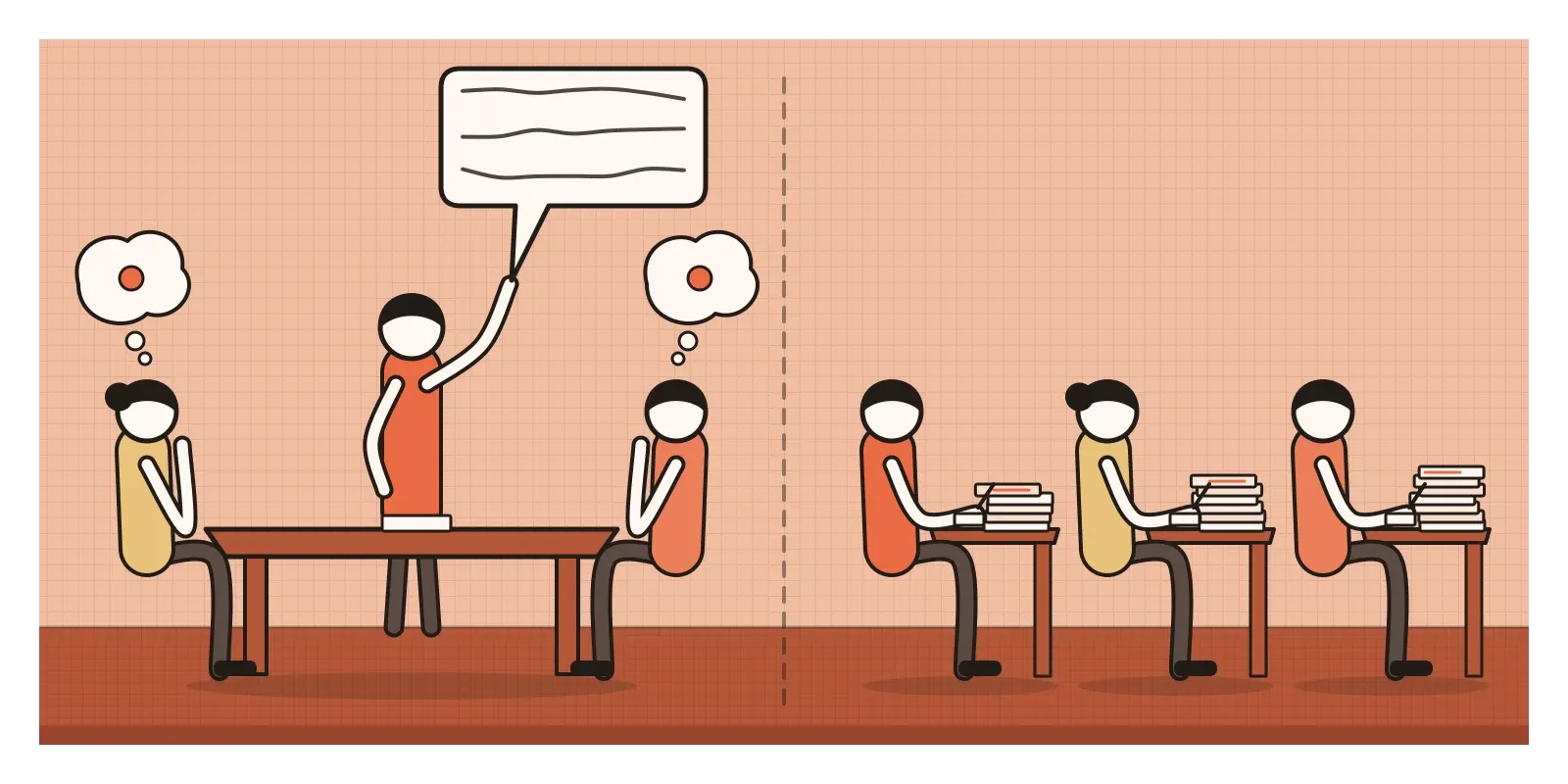
The idea spread through companies all over the world. Then, in 1958, three researchers at Yale, Donald Taylor, Paul Berry and Clifford Block, decided to test the promise. They gave students a set of problems, one of them asking what would happen if everyone were born with an extra thumb on each hand. Some students brainstormed in groups of four, following Osborn's rules. Others worked alone, and the researchers then pooled the ideas of four separate people into what they called a nominal group, a group that only exists on paper. The nominal groups won easily. Four people thinking separately produced far more ideas, and more original ones, than four people thinking together. Many studies since have found the same.
That sounds like bad news for brainstorming, but I think it's more useful than that. Osborn was right that ideas come from quantity and from holding back judgement. He was wrong about how easily a group of people talking in a room could deliver them. Ideation is the stage of design where you generate many possible ideas before choosing any, and the techniques in this post, from brainstorming to SCAMPER to mind maps, are all attempts to make that stage work better.
Why groups get in their own way
Researchers have spent decades working out why group brainstorming underperforms, and three reasons keep coming up. The first, and probably the biggest, was identified by Michael Diehl and Wolfgang Stroebe in 1987. They called it production blocking. In a group, only one person can talk at a time. While you wait your turn, you forget your idea, decide it's not worth saying or get pulled along by someone else's. The second is evaluation apprehension. Despite the rule about not judging, people still worry about looking silly, especially in front of their bosses. The third, social loafing, is simply that in a group it's easy to let others do the work.
None of this means groups are useless. Groups are very good at building on ideas and spotting which ones are worth keeping. The problem is mainly at the start, when ideas first have to come out of people's heads, so the usual fix is to separate the two. In a 2010 study, Karan Girotra, Christian Terwiesch and Karl Ulrich compared teams that brainstormed together from the start with teams whose members first worked alone for a while and then came together. The hybrid teams produced more ideas, and their best ideas were better.
Designers have their own versions of this. One of the oldest is brainwriting, and in particular a method called 6-3-5, developed by the German marketing expert Bernd Rohrbach in the late 1960s. Six people each write three ideas on a sheet in five minutes, then pass the sheet to the next person, who adds three more, building on what's already there. After six rounds, the group has up to 108 ideas, and nobody has had to wait to speak. The Crazy 8s exercise I described in the post on sketching as thinking works on the same principle. Everyone sketches alone, in silence, and only then do the ideas get shared.
SCAMPER, a checklist for poking at an idea
A blank page is a hard place to start. Many ideation techniques give you something to push against instead. Osborn's Applied Imagination included a long list of questions for this, like asking what could be made bigger, smaller, replaced or rearranged. In the early 1970s, an American educator named Bob Eberle turned these into a memorable acronym, SCAMPER, for a book of creative games for children. It stands for Substitute, Combine, Adapt, Modify, Put to other uses, Eliminate and Reverse, though people sometimes swap in slightly different words.
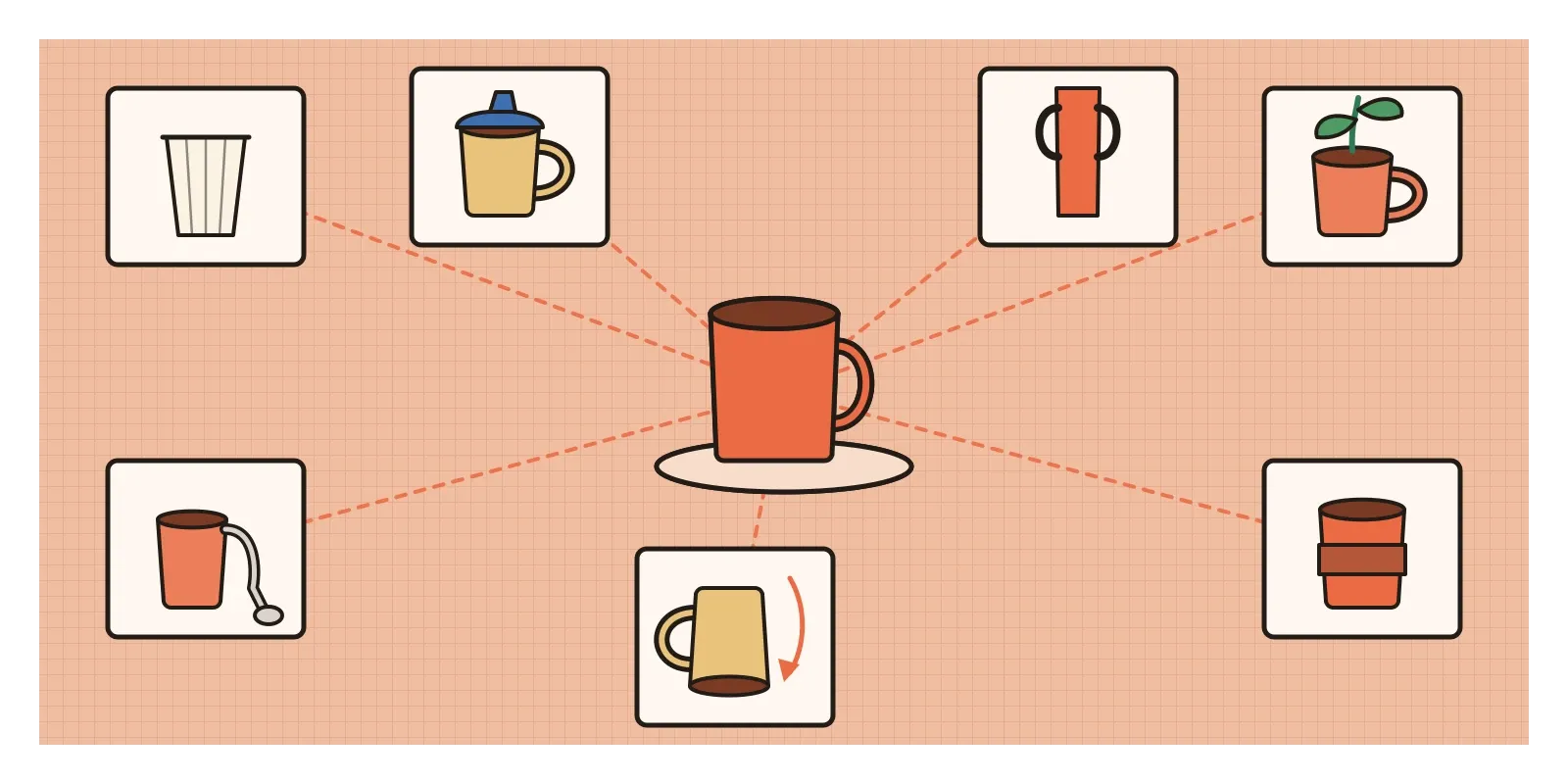
The way to use it is to take an existing thing and run each word over it like a question. Take an ordinary coffee mug. Substitute: what if it were made of folded paper or a heat-holding material? Combine: what if the mug and the spoon were one object? Adapt: what does a baby's sippy cup or a cyclist's bottle know that a mug doesn't? Modify: what if it were tiny, or tall and thin, or had two handles? Put to other uses: could it be a plant pot or a pen holder? Eliminate: what if there were no handle at all, just a thick wall you could hold? Reverse: what if it were upside down, filled from the bottom? Most answers will be useless. A few will make you see the mug differently, and that's enough.
SCAMPER works because most new things are not invented from nothing. They're existing things that have been combined, adapted, enlarged, shrunk or repurposed. The wheeled suitcase is a suitcase combined with wheels. A list of transformations is a way of borrowing that pattern deliberately, instead of waiting for it to strike.
Mind maps, odd prompts and better questions
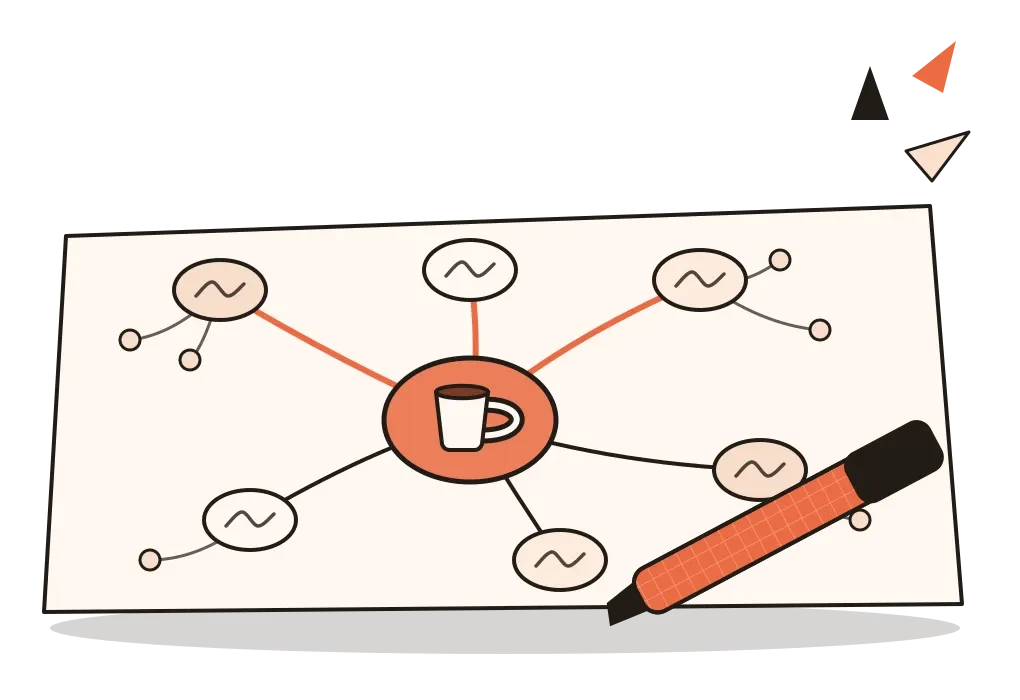
Another family of techniques is about wandering, deliberately letting one thought lead to another. The best known is the mind map, popularised by the British writer Tony Buzan in his 1974 book Use Your Head, which went with a BBC television series. You write or draw a central topic in the middle of a page, then branch outwards with related ideas, then branch again from those, using colour, little drawings and single words rather than sentences. Branching diagrams are much older than Buzan, but his version became hugely popular. Some of his larger claims about how it unlocks the brain go well beyond the evidence, and studies of mind maps as a study aid have found modest benefits rather than dramatic ones. As an ideation tool, though, its value is simple. It lets you see many connected ideas at once, and the empty space at the end of each branch quietly asks for one more.
Other techniques add a deliberate jolt. Edward de Bono, who introduced the term lateral thinking in the 1960s, suggested picking a random word, from a dictionary or anywhere else, and forcing a connection between it and your problem. If you're designing a bus stop and the word is "umbrella", you might start thinking about shelters that open and close. The connection is artificial, but it pulls your thinking out of its usual grooves.
Finally, there's the question itself. In the 1970s, the creativity researcher Min Basadur, then working at Procter & Gamble, encouraged teams to phrase problems as questions starting with "How might we". Instead of "our app's sign-up is too long", you'd write "How might we let people start using the app before they sign up?" The wording matters: "how" assumes a solution exists, "might" gives permission to suggest ideas that might not work, and "we" makes it a shared problem. It links back to what I wrote in the post on solving the problem or finding it. The way you frame a question decides which ideas you'll even think of.
Jugaad, and the danger of romanticising it
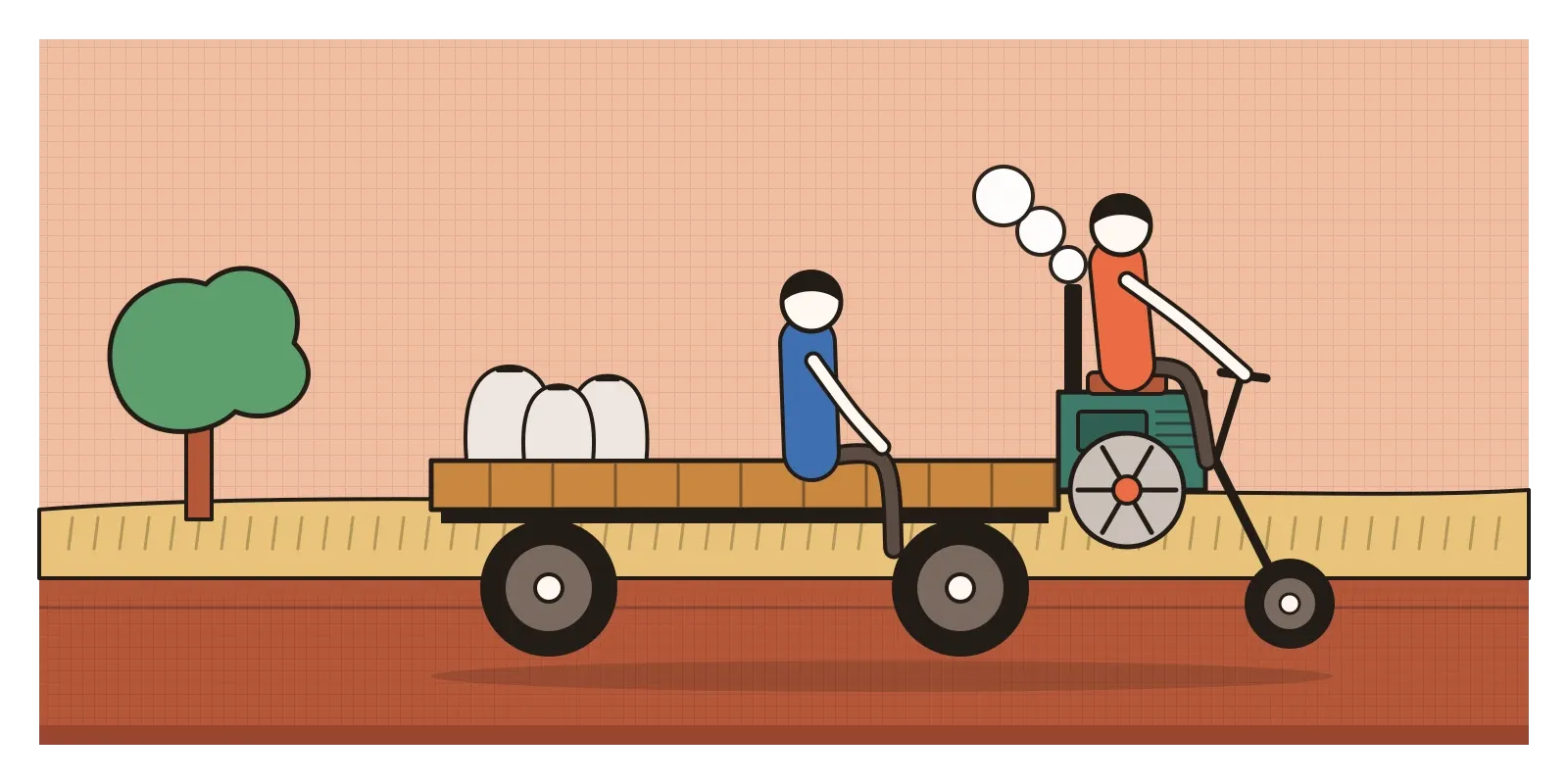
In India, the word that often comes up in conversations about ideas is jugaad, a Hindi word for a clever, improvised fix made with whatever is at hand. The classic example is the vehicle that gave the word much of its fame, the jugaad of rural north India: a wooden or metal cart joined to a diesel engine originally meant for running an irrigation pump, used to carry people, crops and goods between villages. It's SCAMPER in the wild, combining one thing with another and putting a machine to a use it was never designed for.
In 2012, the idea got a business-book makeover in Jugaad Innovation by Navi Radjou, Jaideep Prabhu and Simone Ahuja, which presented it as a model of frugal, flexible innovation that companies everywhere could learn from. There's something real there. Tight constraints and unexpected materials are reliable sources of fresh ideas, and people who improvise every day often get very good at it.
But I'd be careful about celebrating jugaad too uncritically, and many Indian writers and designers feel the same. The jugaad vehicles themselves are often unregistered and unsafe, with poor brakes and no protection in a crash, and authorities have repeatedly tried to keep them off public roads. More broadly, jugaad is often what people do when proper infrastructure, money or safety standards aren't available. Admiring the ingenuity is fine. Treating the shortage as a design philosophy is not. The useful lesson for ideation is narrower: constraints and odd combinations can spark ideas, but an improvised fix is only the beginning of a good design, not the end of one.
Ideation on screens, and the pull of the first example
In product design, ideation usually happens under time pressure, so it helps to have a simple routine. A version that works well for many teams goes like this. Write the problem as one or two "How might we" questions. Give everyone ten minutes to generate ideas alone, in words or rough sketches. Then share them on a wall or a digital whiteboard, group similar ones together and build on each other's. Only after that should anyone start judging, which I'll come back to in the next post, on divergent and convergent thinking.
There's one trap worth knowing about before you start, because screens make it worse. In 1991, the researchers David Jansson and Steven Smith gave engineering students a design task and showed some of them an example solution first. The students who saw the example produced designs that copied its features, even features the researchers had deliberately made faulty and had warned the students about. They called this design fixation. Once you've seen one answer, it's surprisingly hard to think of answers that look different.
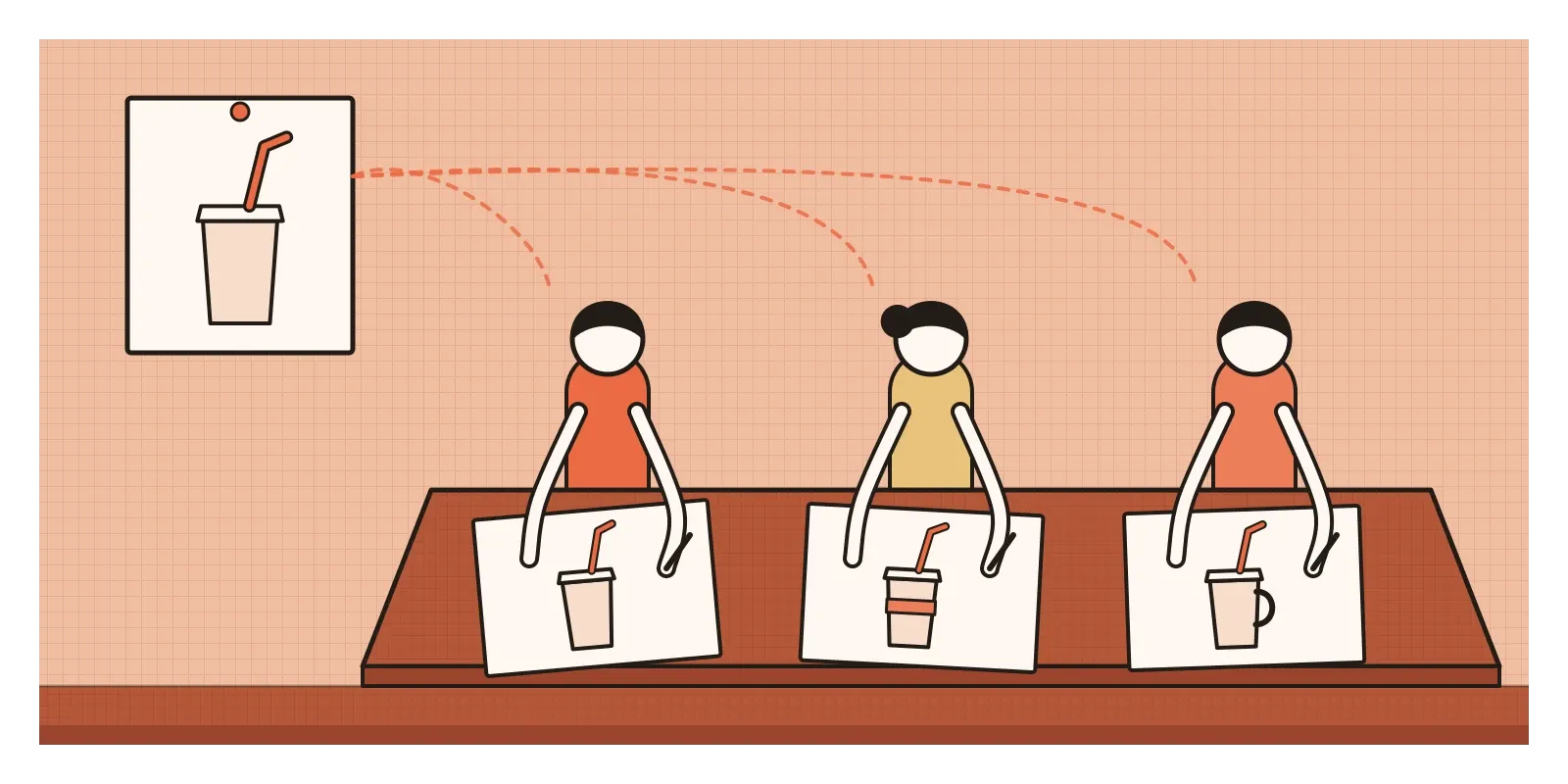
Digital design is full of examples waiting to fix you in place: screenshots from popular apps, component libraries, templates and now AI tools that will generate a dozen polished layouts from a sentence. These can be useful, but they can also narrow the range of ideas a group produces. In a 2024 study, Anil Doshi and Oliver Hauser asked people to write short stories, some with ideas suggested by an AI model. The stories written with AI help were rated as more creative on average, but they were also more similar to each other. Each person did a bit better, while the group as a whole became less varied.
The practical answer is a matter of order. Do your own thinking first, alone, before looking at references or asking an AI for suggestions. Then use those tools to push further and to check what's already out there. Treat anything a tool generates as one more idea on the wall, not as the answer.
Separate the making of ideas from the judging of them
If I had to boil all of this down to one rule, it would be the one Osborn got right in 1939. Keep generating ideas and judging them apart. Most of the techniques in this post are really ways of protecting that early, messy stage from criticism, from fixation and from the pressure of other people in the room. The other thing Osborn got right was quantity. You won't recognise a good idea until you have several to compare it with.
Here's an exercise for this week. Pick an everyday object near you, a water bottle, a bag, a light switch or the app you open most often. Set a timer for seven minutes and spend one minute on each letter of SCAMPER, writing or sketching at least one idea per letter, however silly. Don't stop to judge. When the timer ends, look at the page and mark the one idea you'd most like to see actually made. It doesn't have to be practical, just one you wouldn't have thought of without the prompt.
Osborn's promise about groups didn't survive the Yale experiment, but his instinct about ideas did. People do have more ideas than they think. They just need the right conditions to get them out: a little time alone, a prompt to push against, permission to be wrong and someone waiting to build on what they've made.
Further reading: Alex Osborn, Applied Imagination (1953) · Michael Diehl and Wolfgang Stroebe, "Productivity loss in brainstorming groups: Toward the solution of a riddle" (1987) · David Jansson and Steven Smith, "Design fixation" (1991) · Tony Buzan, Use Your Head (1974) · Navi Radjou, Jaideep Prabhu and Simone Ahuja, Jugaad Innovation (2012)