The Bandwagon Fallacy
Why "everyone is doing it" feels like a reason, and what to ask before you climb aboard.
The Bandwagon Fallacy
Three lines on a card at Swarthmore
In the early 1950s, at Swarthmore College in Pennsylvania, the psychologist Solomon Asch invited students to take part in what he described as a test of visual judgement. A volunteer would sit at a table with seven or eight other young men. On a board at the front, Asch showed a card with a single line on it, and next to it a second card with three lines of different lengths. The task was simply to say, out loud and in turn, which of the three matched the first. It was easy. When people did it alone, they almost never got it wrong.
What the volunteer didn't know was that everyone else at the table was working with Asch. For the first couple of rounds they gave the right answer. Then, on a round where the answer was obvious, they all calmly named the same wrong line, one after another. The volunteer, seated near the end, heard the whole group agree before it was their turn. Over the critical rounds, about a third of the volunteers' answers went along with the group. Roughly three quarters of them conformed at least once. Some said afterwards that they began to doubt their own eyes. Others said they knew the group was wrong but didn't want to stand out.
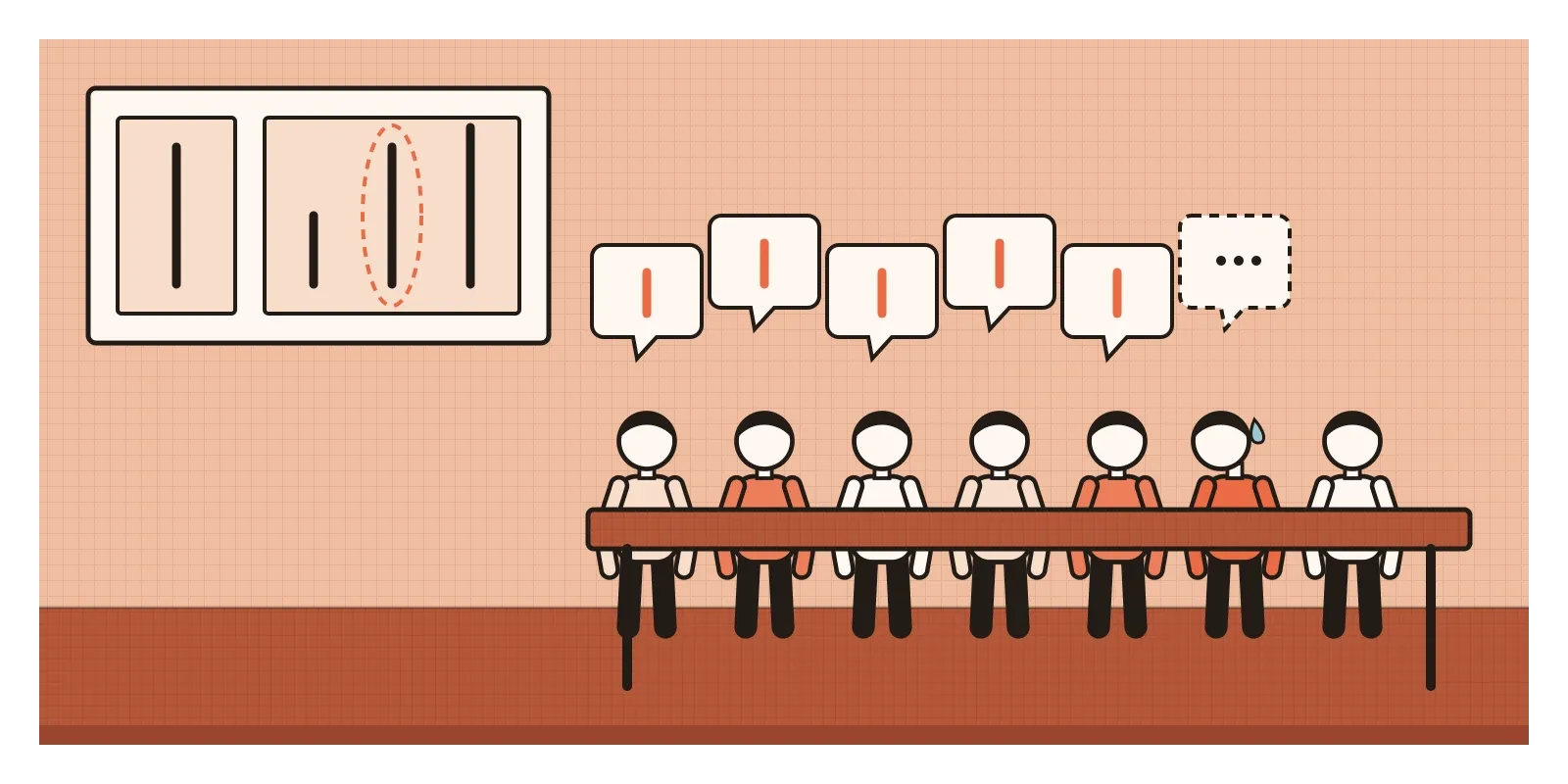
Asch also found something hopeful. When just one other person at the table gave the correct answer, the volunteer's conformity dropped sharply. A single ally was enough to break the spell. It didn't matter so much how many people disagreed with you. What mattered was whether you were completely alone.
Asch was studying conformity, the pressure to fit in, rather than a mistake in argument. But his table is the clearest picture I know of the bandwagon fallacy: treating the fact that many people believe or do something as a reason to think it's true or good. Logicians call it argumentum ad populum, the appeal to the people, and it also goes by the appeal to popularity or the appeal to the majority. "Millions of people use it, so it must be good." "Every serious company is doing this, so we should too." The popularity of a claim and the truth of a claim are two separate questions, and the fallacy quietly swaps one for the other.
Everybody's doing it
The appeal is ancient. Philosophers have long discussed an argument, which appears in Cicero, that because nearly every people on earth believes in gods, gods must exist. It was later given the name consensus gentium, the agreement of the peoples. Whatever you think of its conclusion, its form is the bandwagon's: lots of people believe it, therefore it's true.
The word "bandwagon" is much more recent and much more American. A bandwagon was the wagon that carried the band at the head of a circus parade. The usual story is that the circus clown Dan Rice invited the presidential candidate Zachary Taylor to ride on his bandwagon in 1848, and that the image of politicians rushing to climb aboard a winning campaign grew from there. Like many origin stories it may be tidier than the truth, but by the early twentieth century "jumping on the bandwagon" meant joining whatever seemed to be winning.
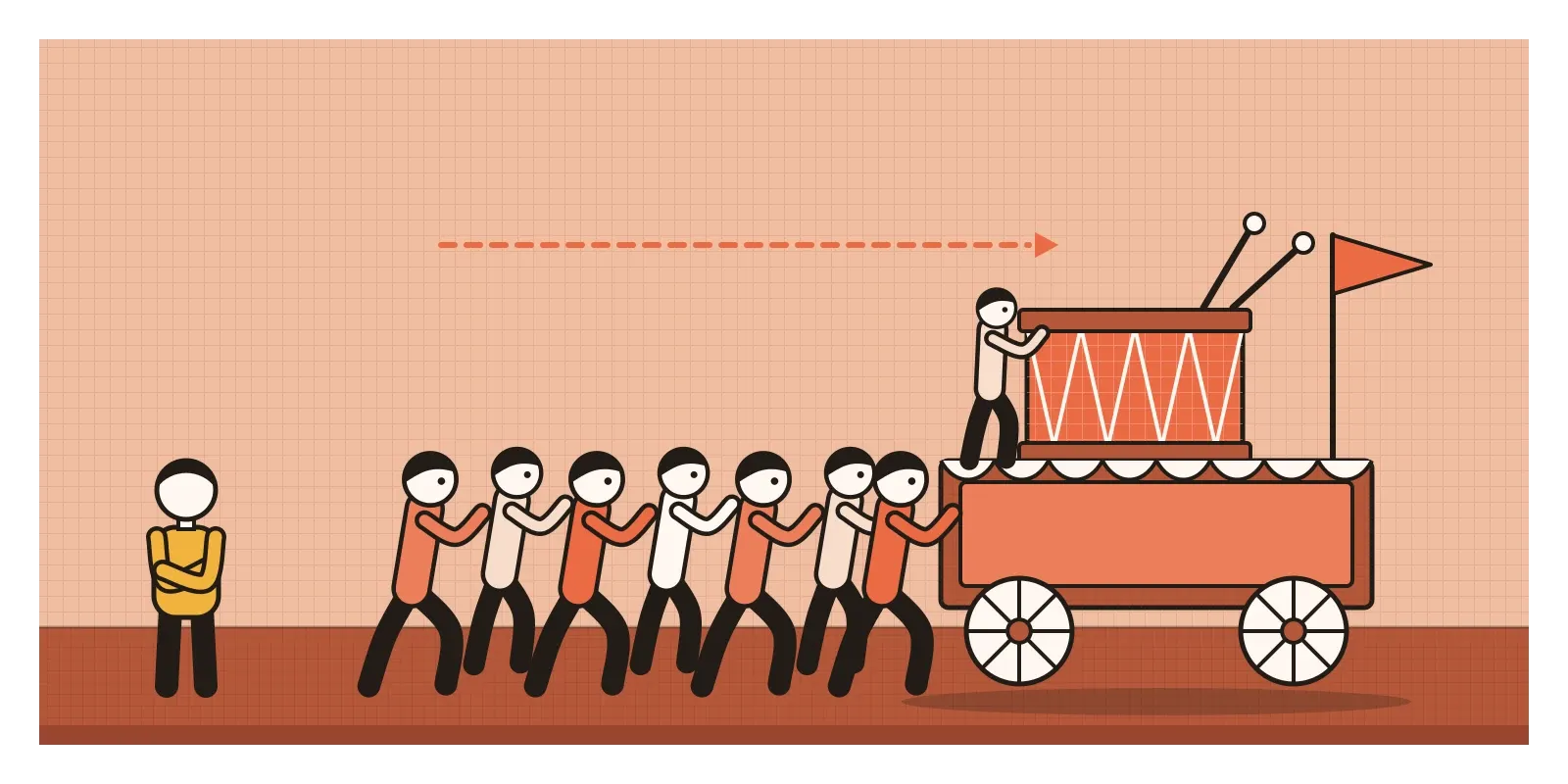
In 1937, a group of American educators founded the Institute for Propaganda Analysis to help ordinary people recognise manipulation in speeches, newspapers and radio. They named seven common devices, and one of them was the "band wagon": the suggestion that everybody, or at least everybody like you, is already on board, so you'd better follow. Advertisers have never stopped using it. In 1959, Elvis Presley's record company released a compilation titled 50,000,000 Elvis Fans Can't Be Wrong. As a joke about popularity it's perfect. As an argument, it's the fallacy in one line. Fifty million fans tells you a great deal about how many people enjoyed the music. It tells you nothing about whether you will.
The fallacy has a few close relatives. The appeal to common practice says that because everyone does something, it must be acceptable. The snob appeal runs the other way, flattering us that only a discerning few have discovered something. Both ask us to judge a claim by who else believes it, rather than by the claim itself.
Why the crowd feels like evidence
The bandwagon works on us because, much of the time, following the crowd is sensible. In 1955, the psychologists Morton Deutsch and Harold Gerard separated two reasons we go along with others. Informational influence is when we take other people's choices as evidence about the world: if a restaurant is packed and the one next door is empty, the crowd probably knows something. Normative influence is when we go along to be liked and to avoid the discomfort of standing apart, which is what many of Asch's volunteers described. The first is often reasonable. The second has nothing to do with whether the claim is true. The fallacy lives in confusing them.
Even informational influence can go badly wrong when people copy each other instead of judging independently. In 1992, the economists Sushil Bikhchandani, David Hirshleifer and Ivo Welch described what they called informational cascades. Once a few people have chosen something, the people after them can rationally ignore their own judgement and follow, so a crowd can form around a choice that rests on very little information. A crowd of copies is not a crowd of witnesses.
In 2006, the sociologists Matthew Salganik, Peter Dodds and Duncan Watts tested this with music. More than fourteen thousand people visited a website where they could listen to and download songs by bands nobody had heard of. Some saw only the song titles. Others were split into separate "worlds" where they could also see how many times each song had been downloaded by earlier visitors in their world. When people could see the counts, popularity became much more unequal and much less predictable. The same song could be a hit in one world and ignored in another, depending on which songs happened to get early downloads. The very best songs rarely did badly, but beyond that, the crowd was mostly following itself.
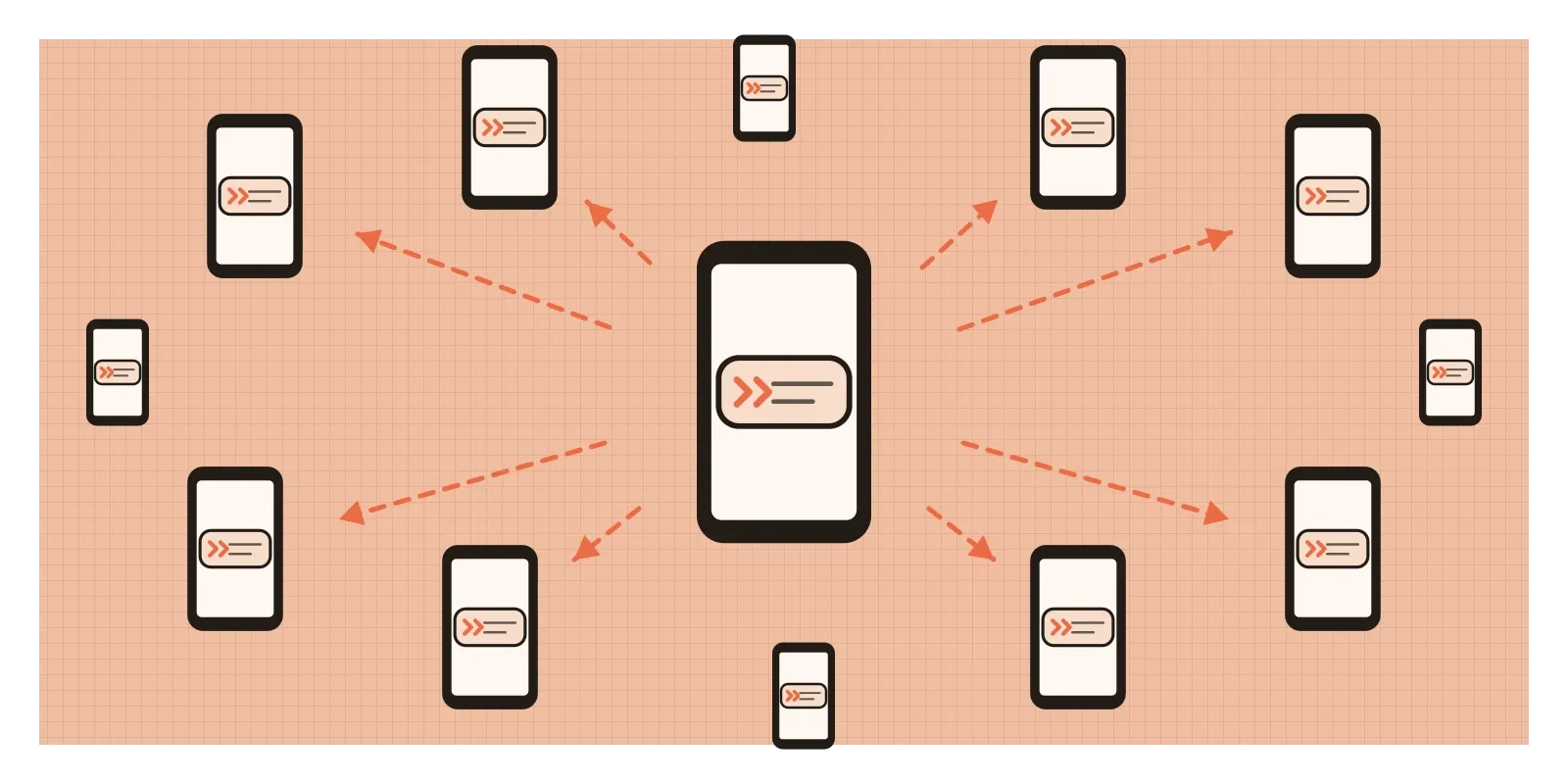
India learned how dangerous this can be. In 2017 and 2018, false rumours about child kidnappers spread through WhatsApp groups in several states and were linked to a series of mob attacks on innocent people. A message that had been forwarded many times felt credible precisely because so many people seemed to be sharing it. In July 2018, WhatsApp began labelling forwarded messages and limited forwarding in India to five chats at a time. It later added a double-arrow label for messages that had been forwarded many times, and in 2020 it restricted those to one chat at a time. I find that a quietly brilliant design decision. It took the very thing that made a rumour feel trustworthy, how widely it had travelled, and turned it into a gentle warning.
When a whole industry pivoted
In the mid 2010s, many digital publishers became convinced that the future of news was video, especially video on Facebook. Facebook was promoting video heavily, advertisers paid more for it, and every week another publisher announced it was moving in that direction. In 2017, outlets including Mic, Vocativ, MTV News and Fox Sports laid off writers and editors as they shifted towards video. The phrase "pivot to video" became a running joke in the industry, mostly because so many companies were doing it at once.
Part of what fed the rush was a number that turned out to be wrong. In September 2016, Facebook told advertisers that, for about two years, it had overstated the average time people spent watching videos on its platform, because the calculation had left out very short views. Many of the big video audiences that publishers were chasing never quite materialised, and several of the companies that pivoted hardest shrank or were sold within a couple of years. Not every decision in that era was foolish, and video did become important. But a lot of newsrooms were persuaded less by their own readers than by the sight of everyone else turning in the same direction.
Picture a roadmap with a chatbot on it
Picture a team at a personal finance app planning its next quarter. The product lead opens with a slide of competitors' screenshots. Five of them have launched an AI assistant in the past six months, each with a little chat bubble in the corner. "Everyone is shipping one," she says. "If we don't, we'll look behind." Heads nod. Within twenty minutes, the assistant is the headline item on the roadmap, and nobody has mentioned a single thing their own users have asked for.

Look at what the argument actually rests on. Five companies built something, which tells us they believed in it. It doesn't tell us whether it's working for them. Several may be running the same meeting, looking at each other's screenshots. Asch's table is in the room too. The designer who spent last month watching users struggle to understand their own spending patterns has a doubt, but four people have already agreed, and the doubt stays unspoken.
The honest version starts with a different question: what problem would an assistant solve for our users, and how would we know? The team might go back to support tickets and research notes, and find that people mostly want help categorising transactions. An assistant might be the right answer to that. A simple, well-designed categorisation screen might be better. Either way, the decision now rests on evidence about their own users rather than on a row of screenshots. One small habit helps a lot here: before discussing an idea, ask everyone to write down their view privately. Independent opinions first, conversation second.
When the crowd is right
Popularity isn't always irrelevant, and pretending it is would be its own mistake. In 1907, Francis Galton wrote in Nature about a competition at a livestock show in Plymouth, where around eight hundred people paid to guess the weight of an ox once it had been slaughtered and dressed. The middle guess of the crowd was within about one percent of the true weight. The guesses were useful because each person made their own, and many of them knew something about cattle. James Surowiecki's book The Wisdom of Crowds built on stories like this, and he was clear about the conditions: a crowd is wise when its members are diverse, independent and actually informed.
Design has its own good reasons to follow the crowd. People spend most of their time in other apps and websites, so they arrive expecting things to work the way they usually do. A shopping cart in the top right corner, a magnifying glass for search: these conventions are popular because they work, and breaking them carries a real cost. Some products are also valuable precisely because they're popular. A messaging app your friends don't use is not much of a messaging app.
So the test isn't whether a crowd is involved. It's whether the crowd's popularity is evidence about the question you're actually asking. "Most of our users already know this pattern" is a good reason to use it. "Most of our competitors launched this feature" is a reason to look closer, not a reason to copy.
How I try to catch it
The first question I ask is: would I still believe this if nobody else did? If my reasons disappear the moment I imagine the crowd gone, I probably didn't have reasons, only company.
The second is: who exactly is "everyone"? When I hear that everyone is doing something, I try to name them, and then ask whether they decided independently, whether they know something I don't, and whether it's working for them. Often "everyone" turns out to be three companies and a conference talk.
The third is a habit for meetings. I try to make it safe for one person to disagree, and when I can, I'm happy to be that person. Asch showed that a single honest voice could break the spell for everyone else at the table. That voice doesn't need to be loud. It only needs to be there.
In the next post I'll look at a mistake that often travels with this one, picking only the evidence that suits us: cherry picking.
Further reading: Solomon Asch, "Opinions and Social Pressure", Scientific American (1955) · Robert Cialdini, Influence (1984) · Matthew Salganik, Peter Dodds and Duncan Watts, "Experimental Study of Inequality and Unpredictability in an Artificial Cultural Market" (2006) · James Surowiecki, The Wisdom of Crowds (2004) · Cass Sunstein, Conformity (2019)
The question to askWould I still believe this if nobody else did?